MCQ
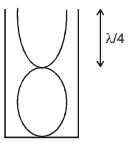
In a closed organ pipe of length $105 \,cm$, standing waves are set up corresponding to third overtone. What distance from the closed end, a pressure node is formed .............. $cm$
  • A
    $5$
  • $15$
  • C
    $25$
  • D
    $30$

Answer

Correct option: B.
$15$
b
(b)

In a closed pipe $f=\frac{(2 P+1)}{4 I} v$

For third overtone $(f)=\frac{7 v}{4 l}$

$\lambda=\frac{v}{f}=\frac{v}{7 v} \times 4 l$

$\lambda=\frac{4 l}{7}$

$\lambda=\frac{4 \times 105}{7}$

$\lambda=60 \,cm$

First pressure node will be formed $\frac{\lambda}{4}$
Need a full question paper?

Generate a complete, print-ready paper with questions like this in minutes — across 16+ boards, with answer keys.
Start Generating Free

Similar questions

Dimensions of kinetic energy are
A car is moving in a circular horizontal track of radius $10\, m$ with a constant speed of $10 \,m/sec$. A plumb bob is suspended from the roof of the car by a light rigid rod of length $1.00\, m$. The angle made by the rod with track is ........ $^o$
A wave going in a solid.
  1. Must be longitudinal
  2. May be longitudinal
  3. Must be transverse
  4. May be transverse.
When three forces of $50 \,N, 30\, N $ and $15\,N$ act on a body, then the body is
A black body is at a temperature of $5760\ K$. The energy of radiation emitted by the body at wavelength $250\ nm$ is $U_1$, at wavelength $500\ nm$ is $U_2$ and that at $1000\ nm$ is $U_3$. Wien's constant, $b = 2.88 \times 10^6\ nm\ K$. Which of the following is correct?
The phase difference between two points separated by $0.8 m$ in a wave of frequency is $120 Hz$ is $\frac{\pi }{2}.$ The velocity of wave is .....  $m/s$
A particle of mass $m$ moves on the x-axis as follows : it starts from rest at $t = 0$ from the point $x = 0$ and comes to rest at $ t= 1$ at the point $x = 1$. No other information is available about its motion at intermediate time $(0 < t < 1)$. If $\alpha $ denotes the instantaneous acceleration of the particle, then
The angle between vectors $(\vec{M} \times \vec{N})$ and $(\bar{N} \times \vec{M})$ is ................
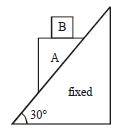
In the given figure acceleration of wedge $'A'$ is $10\ m/s^2$ along the inclined plane. (There is no friction between $A$ $\&$ $B$ and $A$ $\&$ fixed inclined plane.) Then acceleration of block $'B'$ will ............ $m/s^2$
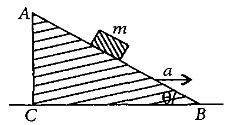
A block of mass $m$ is placed on a smooth inclined wedge $ABC$ of  inclination $\theta$ as shown in the figure. The wedge is given an acceleration $a$ towards the right. The relation between $a$ and $\theta$ for the block to remain stationary on the wedge is