MCQ
In a compound microscope, the intermediate image is
  • A
    Virtual, erect and magnified
  • B
    Real, erect and magnified
  • Real, inverted and magnified
  • D
    Virtual, erect and reduced

Answer

Correct option: C.
Real, inverted and magnified
c
( c)Intermediate image means the image formed by objective, which is real, inverted and enlarged.

Need a full question paper?

Generate a complete, print-ready paper with questions like this in minutes — across 16+ boards, with answer keys.
Start Generating Free

Similar questions

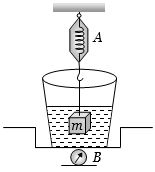
The spring balance $A$ reads $2\, kg$ with a block m suspended from it. $A $ balance $B$ reads $5 \,kg $ when a beaker filled with liquid is put on the pan of the balance. The two balances are now so arranged that the hanging mass is inside the liquid as shown in figure. In this situation
Assertion : Ferro-magnetic substances become paramegnetic above Curie temp.

Reason : Domains are destroyed at high temperature.
Two rectangular blocks $A$ and $B$ of different metals have same length and same area of cross-section. They are kept in such a way that their cross-sectional area touch each other. The temperature at one end of $A$ is $100°C$ and that of $B$ at the other end is $0°C$ . If the ratio of their thermal conductivity is $1 : 3$ , then under steady state, the temperature of the junction in contact will be ........ $^oC$
A current of $1\, mA$ is flowing through a copper wire. How many electrons will pass a given point in one second
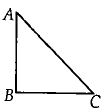
A current carrying closed loop in the form of a right angle isosceles triangle $ABC$ is placed in a uniform magnetic field acting along $AB.$ If the magnetic force on the arm $BC$ is $\vec F,$ the force on the arm $AC$ is
Two point sources $P$ and $Q$ are $24\,cm $ apart. Where should a convex lens of focal length $9\, cm$ be placed in between them so that the images of both sources are formed at the same place?
A $1.00 \times {10^{ - 20}}kg$ particle is vibrating with simple harmonic motion with a period of $1.00 \times {10^{ - 5}}sec$ and a maximum speed of $1.00 \times {10^3}m/s$. The maximum displacement of the particle is
On increasing the length by $0.5\, mm$ in a steel wire of length $2\, m$ and area of cross-section $2\,m{m^2}$, the force required is $[Y$ for steel$ = 2.2 \times {10^{11}}\,N/{m^2}]$
When one of the slits in Young's experiment is covered with a transparent sheet of thickness $3.6 \times {10^{ - 3}}\,cm$. the central fringe shifts to a position originally occupied by $30^{th}$ bright fringe. If $\lambda  = 6000\,\mathop A\limits^o $, then what is the refractive index of the sheet
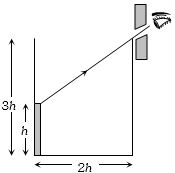
An observer can see through a pin-hole the top end of a thin rod of height $h,$ placed as shown in the figure. The beaker height is $3h$ and its radius $h$. When the beaker is filled with a liquid up to a height $2h$, he can see the lower end of the rod. Then the refractive index of the liquid is