MCQ
In a $\text{CRT}$ the acceleration of electrons is controlled by changing $.......$ between the cathode and anode:
  • Potential difference
  • B
    Space
  • C
    Temperature
  • D
    None of these

Answer

Correct option: A.
Potential difference
Positive potential is given to anode and negative potential is given to cathode. As a result of this potential difference, electrons generated by heating cathode are attracted towards anode due to this potential difference. If no potential difference is applied $b/ w$ anode and cathode in $\text{CRT,}$ no electron would strike the screen. It is because of this potential difference $b/ w$ anode and cathode that the whole process occurs.

Need a full question paper?

Generate a complete, print-ready paper with questions like this in minutes — across 16+ boards, with answer keys.
Start Generating Free

Similar questions

The magnitude of which of the following is proportional to the frequency of the wave?
The power loss in an $AC$ circuit is $E _{ rms } I _{ rms }$, when in the circuit there is only.
A nucleus of mass number $189$ splits into two nuclei having mass number $125$ and $64$ . The ratio of radius of two daughter nuclei respectively is:
In Young's double slit experiment, the amplitudes of the two waves incident on the two slits are $A$ and $2 A$. If $I_{0}$ is the maximum intensity, then the intensity at a spot on the screen, where the phase difference between the two interfering waves is $\phi$.
In an experiment to determine the focal length $(f)$ of a concave mirror by the $u-v$ method, a student places the object pin $A$ on the principal axis at a distance $x$ from the pole $P$. The student looks at the pin and its inverted image from a distance keeping his/her eye in line with $PA$. When the student shifts his/her eye towards left, the image appears to the right of the object pin. Then,
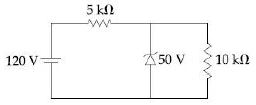
For the circuit shown below, the current through the Zener diode is......$mA$
The half life of a radioactive element which has only $\frac {1}{32}$ of its original mass left after a lapse of 60 days is
A breaker contains water up to a height $h_{1}$ and kerosene of height $h _{2}$ above water so that the total height of (water $+$ kerosene) is $\left( h _{1}+ h _{2}\right.$ ) Refractive index of water is $\mu_{1}$ and that of kerosene is $\mu_{2}$. The apparent shift in the position of the bottom of the breaker when viewed from above is
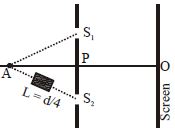
In standard $YDSE$ setup, a small transparent slab containing material of $\mu  = 1.5$ is placed along $AS_2$ (figure). What will be the distance from $O$ of the central maxima $(PO = 1\ m)$ and $(S_1S_2 = d)$
Water fall from a $40\,m$ high dam at the rate of $9 \times 10^{4}\,kg$ per $hour$. Fifty percentage of gravitational potential energy can be converted into electrical energy. Using this hydroelectric energy number of $100\,W$ lamps, that can be lit, is

(Take $\left.g=10\,ms ^{-2}\right)$