MCQ
In a crystal, atoms are located at the position of:
  • A
    Maximum potential energy
  • Minimum potential energy
  • C
    Zero potential energy
  • D
    Infinite potential energy

Answer

Correct option: B.
Minimum potential energy
a crystal, atoms are located at the position of minimum potential energy.
As two atoms approach each other, the potential energy gradually decreases, reaches a minimum value and then sharply increases.

Need a full question paper?

Generate a complete, print-ready paper with questions like this in minutes — across 16+ boards, with answer keys.

Start Generating Free

Similar questions

The reactions of $Cl _2$ gas with cold-dilute and hot-concentrated $NaOH$ in water give sodium salts to two (different) oxoacids of chlorine, $P$ and $Q$, respectively. The $Cl _2$ gas reacts with $SO _2$ gas, in presence of charcoal, to give a product $R$. $R$ reacts with white phosphours to give a compound $S$. On hydrolysis, $S$ gives an oxoacid of phosphours $T$

$1.$ $P$ and $Q$, respectively, are the sodium salts of

$(A)$ hypochlorus and chloric acids

$(B)$ hypochlorus and chlorus acids

$(C)$ chloric and perchloric acids

$(D)$ chloric and hypochlorus acids

$2.$ $R , S$ and $T$, respectively, are

$(A)$ $SO _2 Cl _2, PCl _5$ and $H _3 PO _4$

$(B)$ $SO _2 Cl _2, PCl _3$ and $H _3 PO _3$

$(C)$ $SOCl _2, PCl _3$ and $H _3 PO _2$

$(D)$ $SOCl _2, PCl _5$ and $H _3 PO _4$

Give the answer question $1$ and $2.$
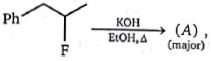
Product $(A)$ is
Optical and geometrical isomerism exhibited by

$(a)$ $[Co(en)_2Cl_2]Br$ 

$(b)$ $[Pt(NH_3)_2Cl_2Br_2]$

$(c)$ $[Co(en)_3]Cl_3$

$(d)$ $[Pt(NH_3)_4Cl_2]$

$(e)$ $[Pt(NH_3)_2Cl_2]$

The most common oxidation state of Lanthanoid elements is $+3$. Which of the following is likely to deviate easily from $+3$ oxidation state?
Sodium or potassium salts of higher fatty acids are called
Which of the following statements is correct?
If Boiling point of water is $100\,^{\circ} C$. How much gram of $NaCl$ is added in $500\, g$ of water to increase the boiling point of water by approx.$1 \,^{\circ} C.\left( K _{ b }\right)_{ H_2O }=0.52\, K.\, kg / mole$
Which of the following can react with alcohols to form esters :
Among the following coordination compounds, the one giving a white precipitate with $\ce{BaCl_2}$ solution is:
When phthalic acid is heated, phthalic anhydride is formed, $IUPAC$ name of phthalic anhydride is?