Question
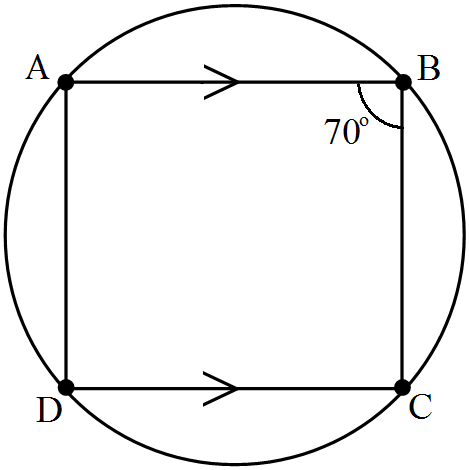
In a cyclic quadrilateral $ABCD$ if $AB || CD$ and $\angle\text{B}=70^\circ,$ find the remaining angles.
Answer


We have, $\angle\text{B}=70^\circ$
Since, $ABCD$ is a cyclic quadrilateral
Then, $​​\angle\text{B}+\angle\text{D}=180^\circ$
$\Rightarrow70^\circ+\angle\text{D}=180^\circ$
$\Rightarrow\angle\text{D}=180^\circ-70^\circ=110^\circ$
Since, $AB || DC$
Then, $\angle\text{B}+\angle\text{C}=180^\circ$ [Co-interior angles]
$\Rightarrow70^\circ+\angle\text{C}=180^\circ$
$\Rightarrow\angle\text{C}=180^\circ-70^\circ=110^\circ$
Now, $\angle\text{A} +\angle\text{C}=180^\circ$ [Opposite angles of cyclic quad.]
$\Rightarrow\angle\text{A}+110^\circ=180^\circ$
$\Rightarrow\angle\text{A}=180^\circ-110^\circ=70^\circ$

Need a full question paper?

Generate a complete, print-ready paper with questions like this in minutes — across 16+ boards, with answer keys.

Start Generating Free

Similar questions

$ABC$ is a Triangle. $D$ is a point on Ab such that $\text{AD}=\frac{1}{4}\text{AD}$ and $E$ is a point on $AC$ such that $\text{AE}=\frac{1}{4}\text{AC.}$ prove that $\text{DE}=\frac{1}{4}\text{BC}.$
$ABC$ is an isoscles triangle in which $AC = BC. AD$ are respectively two altitudes to sides $BC$ and $BC.$ prive that $AE = BD.$
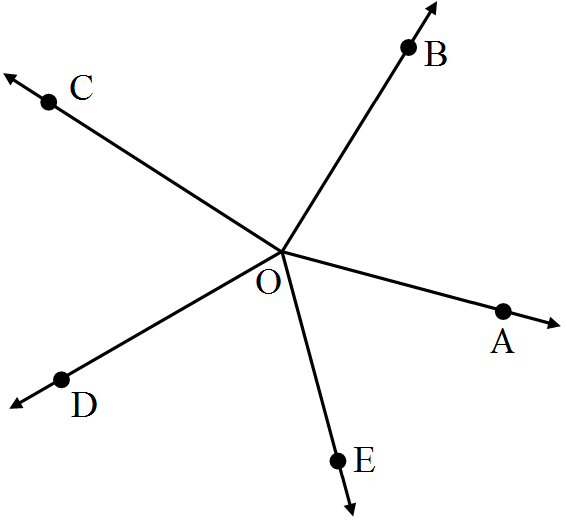
In figure, rays $OA, OB, OC, OD$ and $OE $have the common end point $O$. Show that $\angle\text{AOB}+\angle\text{BOC}+\angle\text{COD}+\angle\text{DOE}+\angle\text{EOA}=360^\circ.$
If both $x+1$ and $x-1$ are factors of $a x^3+x^2-2 x+b$, find the values of $a$ and $b$.
Find rational numbers $a$ and $b$ such that: $\frac{\sqrt{2}-1}{\sqrt{2}+1}=\text{a}+\text{b}\sqrt{2}$
$ABCD$ is such a quadrilateral that $A$ is the centre of the circle passing through $B, C$ and $D.$ Prove that $\angle\text{CBD}+\angle\text{CDB}=\frac{1}{2}\angle\text{BAD}$
A right angled triangles of which the sides containing the right angle are $6.3\ cm$ and $10\ cm$ in length, is made to turn round on the longer side. Find the volume of the solid, thus generated. Also, find its curved surface area.
In a triangle $ABC, D$ is the mid-point of side AC such that $\text{BD}=\frac{1}{2}\text{AC}.$Show that $\angle\text{ABC}$ is a right angle.
A quadrilateral ABCD is inscribed in a circle such that AB is a diameter and $\angle\text{ADC}=130^\circ.$ Find $\angle\text{BAC}.$
Prove that: $\frac{1}{1+\sqrt{2}}+\frac{1}{\sqrt{2}+\sqrt{3}}+\frac{1}{\sqrt{3}+\sqrt{4}}+\frac{1}{\sqrt{4}+\sqrt{5}}\\+\frac{1}{\sqrt{5}+\sqrt{6}}+\frac{1}{\sqrt{6}+\sqrt{7}}+\frac{1}{\sqrt{7}+\sqrt{8}}+\frac{1}{\sqrt{8}+\sqrt{9}}=2$