Question
In a cyclic quadrilateral ABCD, it is given that $\angle\text{A}=(\text{2x}+4)^\circ,\ \angle\text{B}=(\text{y}+3)^\circ,$ $\angle\text{C}=(\text{2y}+10)^\circ$ and $\angle\text{D}=(\text{4x}-5)^\circ$ Find the four angles.

Answer

Given that in a cyclic quadrilateral ABCD,
$\angle\text{A}=(\text{2x}+4)^\circ,\ \angle\text{B}=(\text{y}+3)^\circ,$ $\angle\text{C}=(\text{2y}+10)^\circ$ and $\angle\text{D}=(\text{4x}-5)^\circ$
We know that,
Opposite angles of a quadrilateral sum upto 180°
$\Rightarrow\angle\text{B}+\angle\text{D}=180^\circ$
⇒ (y + 3)° + (4x - 5)° = 180°
⇒ 4x + y = 182 ...(i)
Similarly, $\angle\text{A}+\angle\text{C}=180^\circ$
⇒ (2x + 4)° + (2y + 10)° = 180°
⇒ 2x + 2y = 166
⇒ x + y = 83 ...(i)
Subtracting (ii) from (i), we get
⇒ 3x = 99
⇒ x = 33
Substituting x = 33 in (ii), we get
⇒ y = 50
Hence, the angles of ABCD are
So, $\angle\text{A}=70^\circ,\ \angle\text{B}=53^\circ,$ $\angle\text{C}=110^\circ$ and $\angle\text{D}=127^\circ$

Need a full question paper?

Generate a complete, print-ready paper with questions like this in minutes — across 16+ boards, with answer keys.
Start Generating Free

Similar questions

A chord 10cm long is drawn in a circle whose radius $5\sqrt{2}\text{cm}.$ find the areas of both the segments. $[\text{Take }\pi=3.14]$
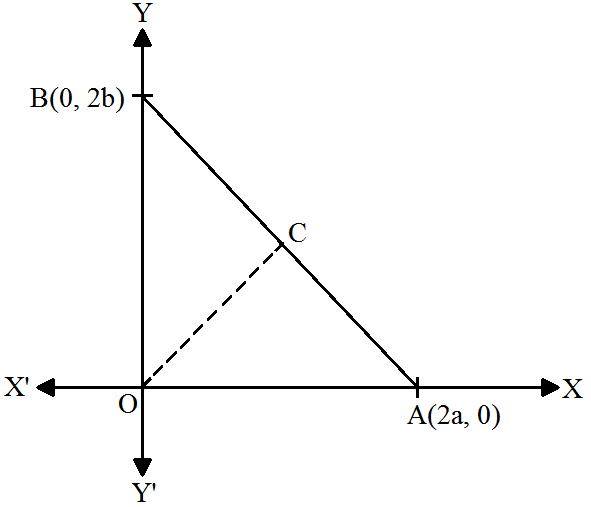
In Fig., a right triangle BOA is given C is the mid-point of the hypotenuse AB. Show that it is equidistant from the vertices O, A and B.
Draw a right triangle in which sides (other than the hypotenuse) are of lengths 8cm and 6cm. Then construct another triangle whose sides are $\frac{3}{4}$ times the corresponding sides of the first triangle.
A shopkeeper buys a number of books for $₹ 1,800$ . If he had bought $15$ more books for the same amount, then each book would have cost him $₹ 20$ less. Find how many books he bought initially.
The product of two consecutive positive integers is 306. Find the integers.
Find the ratio in which the point $\text{P}\Big(\frac{3}{4},\frac{5}{12}\Big)$ divides the line segment joining the points $\text{A}\Big(\frac{1}{2},\frac{3}{2}\Big)$ and B(2, -5).
Solve the following systems of equations by using the method of cross multiplication:
$3x - 2y + 3 = 0$
$4x + 3y - 47 = 0$
The area of a rectangle gets reduced by $8 m^2$, when its length is reduced by 5 m and its breadth is increased by 3 m . If we increase the length by 3 m and breadth by 2 m , the area is increased by $74 m^2$. Find the length and the breadth of the rectangle.
If $\text{a}\cos\theta+\text{b}\sin\theta=\text{m}$ and $\text{a}\sin\theta-\text{b}\cos\theta=\text{n},$ prove that $\big(\text{m}^2+\text{n}^2\big)=\big(\text{a}^2+\text{b}^2\big).$
Area of a sector of central angle $200^\circ$ of a circle s $770cm^2$. Find the length of the corresponding are of this sector.