Question
In a $dc$ motor, induced $e.m.f.$ will be maximum 

Answer

Flux change $\propto $ speed of motor.

Need a full question paper?

Generate a complete, print-ready paper with questions like this in minutes — across 16+ boards, with answer keys.
Start Generating Free

Similar questions

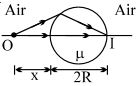
The figure, shows a transparent sphere of radius $R$ and refractive index $\mu$ . An object $O$ is placed at a distance $x$ from the pole of the first surface so that a real image is formed at the pole of the exactly opposite surface. If an object is placed at a distance $R$ from the pole of first surface, then the real image is formed at a distance $R$ from the pole of the second surface. The refractive index $\mu$ of the sphere is given by
An arc lamp requires a direct current of $10\ A$ at $80\ V$ to function. If it is connected to a $ 220\ V (rms ), 50\ Hz\ AC$ supply, the series inductor needed for it to work is close to :
Two point charges $A$ and $B$, having charges $+Q$ and $- Q$ respectively, are placed at certain distance apart and force acting between them is $\mathrm{F}$. If $25 \%$ charge of $A$ is transferred to $B$, then force between the charges becomes
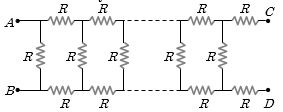
In the figure, the value of resistors to be connected between $C$ and $D$ so that the resistance of the entire circuit between $A$ and $B$ does not change with the number of elementary sets used is
At what temperature the centigrade (Celsius) and Fahrenheit, readings are the same ........ $^o$
A $2 \,m$ long rod of radius $1 \,cm$ which is fixed from one end is given a twist of $0.8$ radians. The shear strain developed will be
Aboat having a speed of $5\,\, km/hr$. in still water, crosses a river of width $1\,\, km$ along the shortest possible path in $15 \,\,minutes$. The speed of the river in $Km/hr.$
Which of the following is heavily doped ?

$(a)$ Photo diode
$(b)$ Light emitting diode
$(c)$ Zener diode
$(d)$ Solar cell

Two slits are separated by $0.3\, mm$. $A$ beam of $500\, nm$ light strikes the slits producing an interference pattern. The number of maxima observed in the angular range $- 30^o < \theta < 30^o.$
In an experiment with sonometer when a mass of $180\,g$ is attached to the string, it vibrates with fundamental frequency of $30\,Hz$. When a mass $m$ is attached, the string vibrates with fundamental frequency of $50\,Hz$. The value of $m$ is $.........\,g$.