Question
In a diode valve the cathode temperature must be (f = work function)(a) High and ∅  should be high(b) High and ∅ should be low(c) Low and ∅ should be high(d) Low and ∅ should be high


Answer

(b) High and ∅ should be low

Need a full question paper?

Generate a complete, print-ready paper with questions like this in minutes — across 16+ boards, with answer keys.
Start Generating Free

Similar questions

When we clap our hands, the sound produced is best described by-
  1. $\text{p}=\text{p}_0\sin(\text{kx}-\omega\text{t})$
  2. $\text{p}=\text{p}_0\sin\text{kx}\cos\omega\text{t}$
  3. $\text{p}=\text{p}_0\cos\text{kx}\sin\omega\text{t}$
  4. $\text{p}=\sum\text{p}_{0\text{n}}\sin(\text{k}_\text{n}\text{x}-\omega_\text{n}\text{t}).$
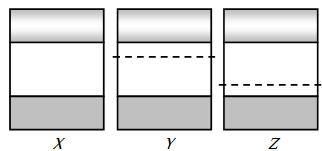
The energy band diagrams for three semiconductor samples of silicon are as shown. We can then assert that
When two bar magnets are coaxially placed at some distance from each other, then no torque works because:
If the Q value of an endothermic reaction is 11.32MeV, then the minimum energy of the reactant nuclei to carry out the reaction is (in laboratory frame of reference)
In an elastic collision:
  1. The kinetic energy remains constant.
  2. The linear momentum remains constant.
  3. The final kinetic energy is equal to the initial kinetic energy.
  4. The final linear momentum is equal to the initial linear momentum.
If potential  V = 100 ± 0.5 Volt and current I = 10  ± 0.2 amp are given to us.  Then what will be the value of resistance(a) 10 ± 0.7 ohm (b) 5 ± 2 ohm(c) 0.1 ± 0.2 ohm(d) None of these
       
Given three equal resistors, how many different combination of all the three resistors can be made(a) Six(b) Five(c) Four(d) Three
       
A parallel plate capacitor is made by stacking n equally spaced plates connected alternately. If the capacitance between any two plates is  C then the resultant capacitance is(a) C(b) nC (c) (n – 1)C(d) (n + 1)C
       
Which of the following properties of light conclusively support wave theory of light?
  1. Light obeys laws of reflection.
  2. Speed of light in water is smaller than the speed in vacuum.
  3. Light shows interference.
  4. Light shows photoelectric effect.
An electron is travelling along the X-direction. It encounters a magnetic field in the Y-direction. Its subsequent motion will be: