Question
In a double slit interference experiment, the separation between the slits is 1.0mm, the wavelength of light used is 5.0 × 10⁻⁷m and the distance of the screen from the slits is 1.0m.
  1. Find the distance of the centre of the first minimum from the centre of the central maximum.
  2. How many bright fringes are formed in one centimeter width on the screen?
Answer

Given that, d = 1mm = 10-3m, D = 1m.
So, fringe with $=\frac{\text{D}\lambda}{\text{d}}=0.5\text{mm}.$
  1. So, distance of centre of first minimum from centre of central maximum $=\frac{0.5}{2}\text{mm}=0.25\text{mm}$
  2. No. of fringes $\frac{10}{0.5}=20.$

Need a full question paper?

Generate a complete, print-ready paper with questions like this in minutes — across 16+ boards, with answer keys.

Start Generating Free

Similar questions

Sketch graph to show how charge Q given to a capacitor of capacitance C varies with the potential difference.
An electron enters with a velocity v = v0i into a cubical region (faces parallel to coordinate planes) in which there are uniform electric and magnetic fields. The orbit of the electron is found to spiral down inside the cube in plane parallel to the x-y plane. Suggest a configuration of fields E and B that can lead to it.
Write the equation of P.E. of electric dipole in external electric field and discuss its special cases.
Find the maximum potential difference which may be applied across an X-ray tube with tungsten target without emitting any characteristic K or L X-ray. The energy levels of the tungsten atom with an electron knocked out are as follows.
Cell containing vacancy
K
L
M
Energy in keV
69.5
11.3
2.3
Find the maximum wavelength of electromagnetic radiation which can create a hole-electron pair in germanium. The band gap in germanium is 0.65eV.
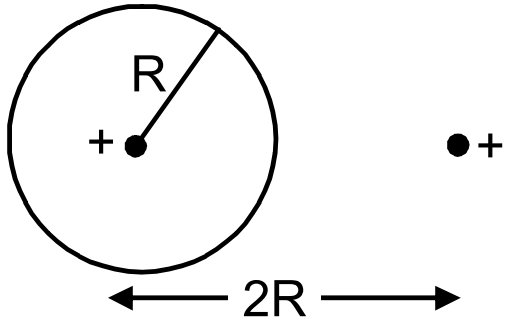
Find the flux of the electric field through a spherical surface of radius R due to a charge of 10-7C at the centre and another equal charge at a point 2R away from the centre.

The current in a discharging LR circuit is given by $\text{i}=\text{i}_0\text{e}^{\frac{-\text{t}}{\tau}}$ where $\tau$ is the time constant of the circuit. Calculate the rms current for the period $\text{t}=0$ to $\text{t}=\tau.$
Show that there can be no net charge in a region m which the electric field is uniform at all points.
What is absolute refractive index? On what factors does it depend ?
Explain the excited states for the hydrogen atom.