MCQ
In a electrochemical cell
- APotential energy changes into kinetic energy
- BKinetic energy changes into potential energy
- ✓Chemical energy changes into electrical energy
- DElectrical energy changes into chemical energy
Generate a complete, print-ready paper with questions like this in minutes — across 16+ boards, with answer keys.
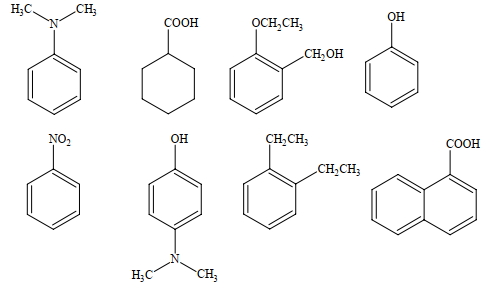
Isomer $(P) \Rightarrow$ Can be prepared by Gabriel phthalimide synthesis
Isomer $(Q) \Rightarrow$ Reacts with Hinsberg's reagent to give solid insoluble in $NaOH$
Isomer (R) $\Rightarrow$ Reacts with $HONO$ followed by $\beta$-naphthol in $NaOH$ to give red dye.
Isomers $( P ),( Q )$ and $( R )$ respectively are
$(A)\xrightarrow{{\operatorname{Re}duction}}(B)\xrightarrow{{HN{O_2}}}{C_2}{H_5}OH$
| List $I$ Complex | List $II$ $CFSE(\Delta_0)$ |
| $A$ $\left[ Cu \left( NH _3\right)_6\right]^{2+}$ | $I$ $-0.6$ |
| $B$ $\left[\operatorname{Ti}\left( N _2 O \right)_6\right]^{3+}$ | $II$ $-2.0$ |
| $C$ $\left[ Fe ( CN )_6\right]^{3-}$ | $III$ $-1.2$ |
| $D$ $\left[ NiF _6\right]^{4-}$ | $IV$ $-0.4$ |
Choose the correct answer from the options given below: