MCQ
In a harmonium the intermediate notes between a note and its octave form
  • A
    An arithmetic progression
  • A geometric progression
  • C
    A harmonic progression
  • D
    An exponential progression

Answer

Correct option: B.
A geometric progression
b
In a harmonium, the intermediate notes between a note and its octave form a geometric progression

Need a full question paper?

Generate a complete, print-ready paper with questions like this in minutes — across 16+ boards, with answer keys.

Start Generating Free

Similar questions

A rod $(AB)$ is attached to a fixed point $(C)$ using a light rope $(AC)$. The other end of the rod $(B)$ is sitting on ice with negligible friction and the system is in stationary position. Which of the following can be the equilibrium configuration of this system?
Two spherical conductors each of capacity $C$ are charged to potentials $V$ and $ - V$. These are then connected by means of a fine wire. The loss of energy will be
In an experiment for determination of the focal length of a thin convex lens, the distance of the object from the lens is $10 \pm 0.1 \mathrm{~cm}$ and the distance of its real image from the lens is $20 \pm 0.2 \mathrm{~cm}$. The error in the determination of focal length of the lens is $n \%$. The value of $n$ is. . . . . . .
The wheel of a car is rotating at the rate of $1200$ revolutions per minute. On pressing the accelerator for $10\ sec$  it starts rotating at $4500$ revolutions per minute.  The angular acceleration of the wheel is 
Which of the following velocity-time graphs shows a realistic situation for a body in motion
A lead bullet of $10\, g$ travelling at $300\, m/s$ strikes against a block of wood and comes to rest. Assuming $50\%$ of heat is absorbed by the bullet, the increase in its temperature is ........ $^oC$

$($Specific heat of lead $= 150\,J/kg, K)$

Identify the gate and match $A, B, Y$ in bracket to check
The specific resistance of manganin is $50 \times {10^{ - 8}}\,ohm \times m$. The resistance of a cube of length $50\,cm$ will be
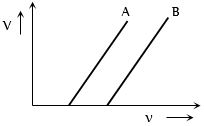
The stopping potential as a function of the frequency of the incident radiation is plotted for two different photoelectric surfaces $A$ and $B$. The graphs show that work function of $A$ is
The electromotive force of a primary cell is $2\, volts$. When it is short-circuited it gives a current of $4$ amperes. Its internal resistance in $ohms$ is