MCQ
In a junction diode, the holes are due to
  • A
    Protons
  • B
    Neutrons
  • C
    Extra electrons
  • Missing of electrons

Answer

Correct option: D.
Missing of electrons
d
(d) In a junction diode, the free electrons combine with a hole and gets converted into a valence electron. Now the thermal energy breaks this electron-hole pair in the depletion layer, the electron drifts to the $n-type$ region leaving behind the hole which drifts to the $p-type$ region.

Need a full question paper?

Generate a complete, print-ready paper with questions like this in minutes — across 16+ boards, with answer keys.
Start Generating Free

Similar questions

$1000$ small water drops each of radius $r$ and charge $q$ coalesce together to form one spherical drop. The potential of the big drop is larger than that of the smaller drop by a factor of
The frequencies at which the current amplitude in an $LCR$ series circuit becomes $\frac{1}{\sqrt{2}}$ times its maximum value, are $212\,rad\,s ^{-1}$ and $232\,rad\,s ^{-1}$. The value of resistance in the circuit is $R =5 \Omega$. The self inductance in the circuit is $.........mH$
How many photons are emitted by a laser source of $5 \times 10^{-3} \,W$ operating at $632.2 \,nm$ in $2 \,s$ is .......$\times 10^{16}$ $\left(h=6.63 \times 10^{-34} \,Js \right)$
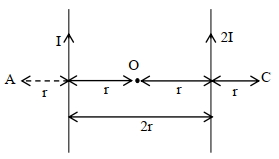
Two parallel long current carrying wire separated by a distance $2 \mathrm{r}$ are shown in the figure. The ratio of magnetic field at $\mathrm{A}$ to the magnetic field produced at $C$ is $\frac{x}{7}$. The value of $x$ is $\qquad$
Given below are two statements : one is labelled as Assertion $A$ and the other is labelled as Reason $R$.

Assertion $A :$ For a simple microscope, the angular size of the object equals the angular size of the image.

Reason $R$ : Magnification is achieved as the small object can be kept much closer to the eye than $25\, cm$ and hence it subtends a large angle.

In the light of the above statements, choose the most appropriate answer from the options given below:

Light from a hydrogen discharge tube is incident on the cathode of a photoelectric cell the work function of the cathode surface is $4.2\ eV$. In order to reduce the photo-current to zero the voltage of the anode relative to the cathode must be made ........... $V$
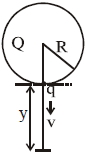
A solid sphere of radius $R$ carries a charge $(Q+q)$ distributed uniformly over its volume. A very small point like piece of it of mass $m$ gets detached from the bottom of the sphere and falls down vertically under gravity. This piece carries charge $q.$ If it acquires a speed $v$ when it has fallen through a vertical height $y$ (see figure), then :

(assume the remaining portion to be spherical).
A plastic disc of radius $R$ has a charge $q$ uniformly distributed over its surface. If the disc is rotated at an angular frequency $\omega$ about it axis, the induction at the center of the disc is :-
Magnifying glass forms:
The magnifying power of a telescope is $9$ . When it is adjusted for parallel rays, the distance between the objective and eyepiece is $20\ cm$ . The focal length of lenses are