MCQ
In a large room, a person receives direct sound waves from a source $120$ metres away from him. He also receives waves from the same source which reach him, being reflected from the $25$ metre high ceiling at a point halfway between them. The two waves interfere constructively for wavelength of
  • $20, 20/3, 20/5$ etc
  • B
    $10, 5, 2.5$ etc
  • C
    $10, 20, 30$ etc
  • D
    $15, 25, 35$ etc

Answer

Correct option: A.
$20, 20/3, 20/5$ etc
a
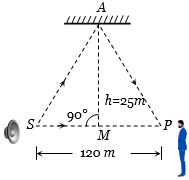
(a) Let $S$ be source of sound and $P$ the person or listner.

The waves from $S$ reach point $P$ directly following the path $SMP$ and being reflected from the ceiling at point $A$ following the path $SAP$.

$M$ is mid-point of $SP$ (i.e. $SM = MP)$ and $\angle \,SMA = {90^o}$

Path difference between waves $\Delta x = SAP - SMP$

We have $SAP = SA + AP = 2(SA)$

$ = $$2\sqrt {[{{(SM)}^2} + {{(MA)}^2}]}  =  2\sqrt {({{60}^2} + {{25}^2})}  =130m$

$\therefore $ Path difference $= SAP -SMP   = 130 - 120 = 10 m$

Path difference due to reflection from ceiling = $\frac{\lambda }{2}$

$\therefore $ Effective path difference $\Delta x = 10 + \frac{\lambda }{2}$

For constructive interference

$\Delta x = 10 + \frac{\lambda }{2} = n\lambda \Rightarrow (2n - 1)\frac{\lambda }{2} = 10(n = 1,\,\,2,\,\,3....)$

$\therefore $ Wavelength $\lambda = \frac{{2 \times 10}}{{(2n - 1)}} = \frac{{20}}{{2n - 1}}$.

The possible wavelength are ?$ = $$20,\,\,\frac{{20}}{3},\,\,\frac{{20}}{5}\,,\,\,\frac{{20}}{7}\,,\,\,\frac{{20}}{9}\,,$…..

$ = $ $20$$m$, $6.67$$m$, $4m,$$2.85\,m,$ $2.22$$m,$…..
Need a full question paper?

Generate a complete, print-ready paper with questions like this in minutes — across 16+ boards, with answer keys.

Start Generating Free

Similar questions

A boat moves with a speed of $5 \,km/h $ relative to water in a river flowing with a speed of $3 \,km/h$ and having a width of $1 \,km$. The minimum time taken around a round trip is.........$min$
The entropy of any system is given by

${S}=\alpha^{2} \beta \ln \left[\frac{\mu {kR}}{J \beta^{2}}+3\right]$

Where $\alpha$ and $\beta$ are the constants. $\mu, J, K$ and $R$ are no. of moles, mechanical equivalent of heat, Boltzmann constant and gas constant repectively. [Take ${S}=\frac{{dQ}}{{T}}$ ]

Choose the incorrect option from the following:

An ideal gas $(\gamma = 1.5)$ is expanded adiabatically. How many times has the gas to be expanded to reduce the root mean square velocity of molecules $2.0$ times
A cubic metal block of mass $5 \,kg$ and edge length $0.1 \,m$ and at an initial temperature of $100^{\circ} C$ is placed on a thermally insulating flat surface and exposed to air at $0^{\circ} C$. The time in seconds required to cool the block to a temperature of $37^{\circ} C$ is closest to

(Note: Specific heat of the metal $=500 \,J / kg /{ }^{\circ} C$; Heat transfer coefficient from block to air $=50 \,W / m ^2 /{ }^{\circ} C$ )

A uniform spring of force constant $k$ is cut into two pieces, the lengths of which are in the ratio $1 : 2$. The ratio of the force constants of the shorter and the longer pieces is
If a simple pendulum is made to oscillate in water, then the time period :
In the experiment to determine the speed of sound using a resonance column,
When unit mass of water boils to become steam at $100\,^0C$, it absorbs $Q$ amount of heat. The densities of water and steam at $100\,^0C$ are $\rho_1$ and $\rho_2$ respectively and the atmospheric pressure is $p_0$. The increase in internal energy of the water is 
A body of mass $m$  starts moving from rest along $x-$ axis so that its velocity varies as $v = a\sqrt s$ where $a$ is a constant and $s$  is the distance covered by the body. The total work done by all the forces acting on the body in the first second after the start of the motion is
The total spring constant of the system as shown in the figure will be