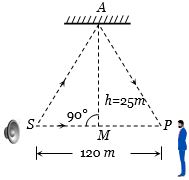
In a large room, a person receives direct sound waves from a source $120$ metres away from him. He also receives waves from the same source which reach him, being reflected from the $25$ metre high ceiling at a point halfway between them. The two waves interfere constructively for wavelength of
Diffcult


Download our appand get started for free
Experience the future of education. Simply download our apps or reach out to us for more information. Let's shape the future of learning together!No signup needed.*
Similar Questions
- 1If two tuning forks $A$ and $B$ are sounded together, they produce $4$ beats per second. $A$ is then slightly loaded with wax, they produce $2$ beats when sounded again. The frequency of $A$ is $256.$ The frequency of $B$ will beView Solution
- 2A police car with a siren of frequency $8$ $kHz$ is moving with uniform velocity $36$ $km/hr$ towards a tall building which reflects the sound waves. The speed of sound in air is $320$ $m/s$. The frequency of the siren heard by the car driver is .... $kHz$View Solution
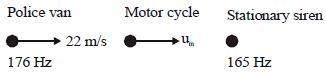
- 3A police van, moving at $22\, m/s$ , chases a motor-cyclist. The police man sounds horn at $176\, Hz$ , while both of them move towards a stationary siren of frequency $165\, Hz$ as shown in the figure. If the motor-cyclist does not observe any beats, his speed must be .... $m/s$ (take the speed of sound $= 330\, m/s$ )View Solution
- 4Equation of motion in the same direction is given by ${y_1} = A\sin (\omega t - kx)$, ${y_2} = A\sin (\omega t - kx - \theta )$. The amplitude of the medium particle will beView Solution
- 5The wavelength is $120 cm$ when the source is stationary. If the source is moving with relative velocity of $60\, m/sec$ towards the observer, then the wavelength of the sound wave reaching to the observer will be ... $cm$ (velocity of sound $= 330 \,m/s$)View Solution
- 6A train blowing its whistle moves with constant speed on a straight track towards observer and then crosses him. If the ratio of difference between the actual and apparent frequencies be $3: 2$ in the two cases, then the speed of train is [ $v$ is speed of sound]View Solution
- 7The ratio of maximum to minimum intensity due to superposition of two waves is $\frac{{49}}{9}$ Then the ratio of the intensity of component waves is .View Solution
- 8A horizontal stretched string, fixed at two ends, is vibrating in its fifth harmonic according to the equation, $y(x$, $t )=(0.01 \ m ) \sin \left[\left(62.8 \ m ^{-1}\right) x \right] \cos \left[\left(628 s ^{-1}\right) t \right]$. Assuming $\pi=3.14$, the correct statement$(s)$ is (are) :View Solution
$(A)$ The number of nodes is $5$ .
$(B)$ The length of the string is $0.25 \ m$.
$(C)$ The maximum displacement of the midpoint of the string its equilibrium position is $0.01 \ m$.
$(D)$ The fundamental frequency is $100 \ Hz$.
- 9View SolutionIn stationary waves, antinodes are the points where there is
- 10A string vibrates according to the equation $y = 5\sin \,\left( {\frac{{2\pi x}}{3}} \right)\,\,\cos \,20\,\pi t$, where $x$ and $y$ are in $cm$ and $t$ in sec. The distance between two adjacent nodes is .... $cm$View Solution