Question
In a meter bridge experiment null point is obtained at $20\, cm$ from one end of the wire when resistance $X$ is balanced against another resistance $Y$. If $X < Y$, then where will be the new position of the null point from the same end, if one decides to balance a resistance of $4X$ against $Y$ ........... $cm$
Answer

a
(a) In balancing condition, $\frac{{{R_1}}}{{{R_2}}} = \frac{{{l_1}}}{{{l_2}}} = \frac{{{l_1}}}{{100 - {l_1}}}$
$ \Rightarrow $ $\frac{X}{Y} = \frac{{20}}{{80}} = \frac{1}{4}$.....$(i)$
and $\frac{{4X}}{Y} = \frac{l}{{100 - l}}$.....$(ii)$
$ \Rightarrow $ $\frac{4}{4} = \frac{l}{{100 - l}}$$ \Rightarrow $ $l = 50\,cm$

Need a full question paper?

Generate a complete, print-ready paper with questions like this in minutes — across 16+ boards, with answer keys.

Start Generating Free

Similar questions

Suppose a ${ }_{88}^{226} Ra$ nucleus at rest and in ground state undergoes $\alpha$-decay to a ${ }_{56}^{22} Rn$ nucleus in its excited state. The kinetic energy of the emitted $\alpha$ particle is found to be $4.44 MeV$. ${ }_{86}^{22} Rn$ nucleus then goes to its ground state by $\gamma$-decay. The energy of the emitted $\gamma$-photon is. . . . . . . .$keV$,

[Given: atomic mass of ${ }_{ gs }^{226} Ra =226.005 u$, atomic mass of ${ }_{56}^{22} Rn =222.000 u$, atomic mass of $\alpha$ particle $=4.000 u , 1 u =931 MeV / c ^2, c$ is speed of the light $]$

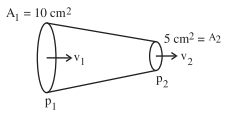
Glycerine of density $1.25 \times 10^3\,kg\,m ^{-3}$ is flowing through the conical section of pipe. The area of cross-section of the pipe at its ends is $10\,cm ^2$ and $5\,cm ^2$ and pressure drop across its length is $3\,Nm ^{-2}$. The rate of flow of glycerine through the pipe is $x \times 10^{-5} m ^3 s ^{-1}$. The value of $x$ is $..............$.
Two travelling waves of equal amplitudes and equal frequencies move in opposite directions along a string. They interfere to produce a stationary wave whose equation is given by $y=\left(10 \cos \pi x \sin \frac{2 \pi t}{T}\right)\, cm$

The amplitude of the particle at $x =\frac{4}{3} \,cm$ will be........ $cm$.

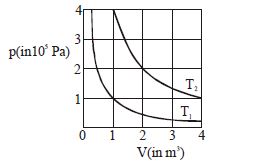
The given diagram shows isotherms for a fixed mass of an ideal gas at temperature $T_1$ and $T_2$ . What is the value of the ratio $\frac{{{\text{r}}{\text{.m}}{\text{.s}}{\text{. speed of the molecules at temperature }}{{\text{T}}_{2{\text{ }}}}}}{{{\text{r}}{\text{.m}}{\text{.s}}{\text{. speed of the molecules at temperature }}{{\text{T}}_1}}}$ ?
A hollow metallic sphere of radius $10 \;cm$ is charged such that potential of its surface is $80\; V$. The potential at the centre of the sphere would be
A plane convex lens is made of refractive index $1.6$. The radius of curvature of the curved surface is $60 cm. $ The focal length of the lens is.....$cm$
Masses  ${\rm{8, 2, 4, 2 }}kg{\rm{ }}$ are placed at the corners $A, B, C, D$ respectively of a square $ABCD$ of diagonal $80\,cm$. The distance of centre of mass from $A$ will be ........ $cm$
Two cylinders $A$ and $B$ fitted with pistons contain equal amounts of an ideal diatomic gas at $300 K$ . The piston of $A$ is free to move while that of $B$  is held fixed. The same amount of heat is given to the gas in each cylinder. If the rise in temperature of the gas in $A$ is $30 K$ , then the rise in temperature of the gas in $B$ is ..... $K$
When the power delivered by a $100\,volt$ battery is $40\,watts$ the equivalent resistance of the circuit is ........... $ohms$
The maximum velocity and the maximum acceleration of a body moving in a simple harmonic oscillator are $2\,m/s$ and $4\,m/{s^2}.$ Then angular velocity will be ..... $rad/sec$