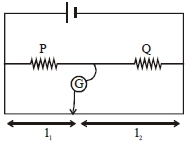
In a meter bridge experiment null point is obtained at $40\, cm$ from one end of the wire when resistance $X$ is balanced against another resistance $Y$. If $X < Y$, then the new position of the null point from the same end, if one decides to balance a resistance of $3X$ against $Y$, will be close to .............. $cm$
JEE MAIN 2013, Diffcult
Download our app for free and get started
From question, $\frac{x}{y}=\frac{40}{100-40}=\frac{2}{3}$
$\Rightarrow x=\frac{2}{3} y$
Again, $\frac{3 x}{y}=\frac{z}{100-z}$
or $\frac{3 \times \frac{2 y}{3}}{y}=\frac{z}{100-z}$
Solving we get $Z=67\, \mathrm{cm}$
Therefore new position of null point
$\cong 67\, \mathrm{cm}$

Download our appand get started for free
Experience the future of education. Simply download our apps or reach out to us for more information. Let's shape the future of learning together!No signup needed.*
Similar Questions
- 1Three resistors each of $4\,\Omega $ are connected together to form a network. The equivalent resistance of the network cannot be ............ $\Omega$View Solution
- 2$10$ resistors each of resistance $10\,\Omega$ can be connected in such as to get maximum and minimum equivalent resistance. The ratio of maximum and minimum equivalent resistance will be $..........$.View Solution
- 3A $220\, volt$, $1000\, W$ bulb is connected across a $110\, volt$ mains supply. The power consumed will be ............ $W$View Solution
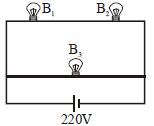
- 4A $100\, W \, bulb\, B_1$ and two $60\, W \,bulbs \,B_2$ and $B_3$, are connected to a $220\, V$ source, as shown in Figure. Now $P_1, P_2$ and $P_3$ are the output powers of the bulbs $B_1, B_2$ and $B_3$ respectively. ThenView Solution
- 5In a wire of circular cross-section with radius $r$, free electrons travel with a drift velocity $V$ when a current $I$ flows through the wire. What is the current in another wire of half the radius and of the same material when the drift velocity is $2V$View Solution
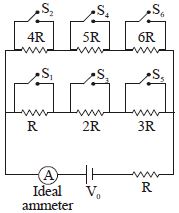
- 6Say switches $S_1, S_2$ and so on upto $S_6$ are closed, one after other in order (first $S_1$, then $S_2$) at regular intervals of $1$ minute starting from $t = 0$. The graph of current versus time is best represented asView Solution
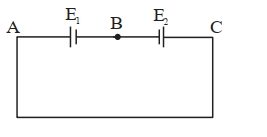
- 7Two cells are connected in opposition as shown. Cell $\mathrm{E}_1$ is of $8 \mathrm{~V}$ emf and $2 \ \Omega$ internal resistance; the cell $E_2$ is of $2 \mathrm{~V}$ emf and $4\ \Omega$ internal resistance. The terminal potential difference of cell $\mathrm{E}_2$ is:View Solution
- 8When connected across the terminals of a cell, a voltmeter measures $5\,V$ and a connected ammeter measures $10\, A$ of current. A resistance of $2\, ohms$ is connected across the terminals of the cell. The current flowing through this resistance will be ............ $A$View Solution
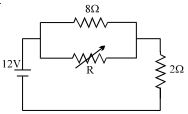
- 9The value of the resistance $R$ in figure is adjusted such that power dissipated in the $2\,\Omega$ resistor is maximum. Under this conditionView Solution
- 10The meter bridge shown is in balanced position with $\frac{\mathrm{P}}{\mathrm{Q}}=\frac{\mathrm{l}_{1}}{\mathrm{l}_{2}}$. If we now litterchange the positions of gavanometer and cell, will the bridge work? If yes, what will be balance condition?View Solution