Question
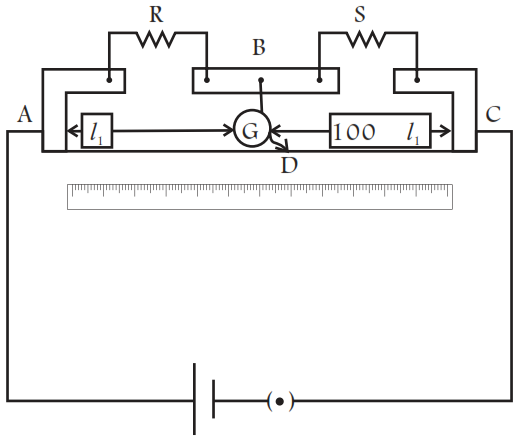
In a meter bridge the point D is a neutral point (Fig).

Answer

  1. The meter bridge can have no other neutral point for this set of resistances.
  1. When the jockey contacts a point on the meter wire to the right of D, current flows from B to the wire through galvanometer.
Solution:
Key concept: Meter bridge: In case of meter bridge, the resistance wire AC is 100cm long. Varying the position of tapping point B, bridge is balanced. If in balanced position of bridge AB = l, BC = (100 - l) so that $\frac{\text{Q}}{\text{P}}=\frac{(100-\text{I})}{\text{I}}$. Also $\frac{\text{P}}{\text{Q}}=\frac{\text{R}}{\text{S}}>\text{S}=\frac{(100-\text{I})}{\text{I R}}$.
When there is no deflection in galvanometer there is no current across the galvanometer, then points B and D are at same potential. That point at which galvanometer shows no deflection is called null point, then potential at B and neutral point D are same. When the jockey contacts a point on the meter wire to the right of D, the potential drop across AD is more than potential drop across AB, which brings the potential of point D less than that of B, hence current flows from B to D in the galvanometer wire.

Need a full question paper?

Generate a complete, print-ready paper with questions like this in minutes — across 16+ boards, with answer keys.
Start Generating Free

Similar questions

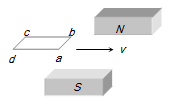
A horizontal loop abcd is moved across the pole pieces of a magnet as shown in fig. with a constant speed $v.$ When the edge ab of the loop enters the pole pieces at time $t = 0 \sec.$ Which one of the following graphs represents correctly the induced emf in the coil
In series L - C - R resonant circuit, to increase the resonant frequency:
An electron with kinetic energy $5\ eV$ is incident on a hydrogen atom in its ground state. The collision$:$
If the phase difference between alternating current and e.m.f. is $\phi$, then the value of power factor is :
A line passing through places having zero value of magnetic dip is called(a) Isoclinic line(b) Agonic line(c) Isogonic line(d) Aclinic line
       
A charged particle goes undeflected in a region containing an electric and a magnetic field. It is possible that
  1. $\overrightarrow{\text{E}}||\overrightarrow{\text{B}},\ \overrightarrow{\text{v}}||\overrightarrow{\text{E}}$
  2. $\overrightarrow{\text{E}}$ is not parallel to $\overrightarrow{\text{B}}$
  3. $\overrightarrow{\text{v}}||\overrightarrow{\text{B}}$ but $\overrightarrow{\text{E}}$ is not parallel to $\overrightarrow{\text{B}}$
  4. $\overrightarrow{\text{E}}||\overrightarrow{\text{B}}$ but $\overrightarrow{\text{v}}$ is not parallel to $\overrightarrow{\text{E}}$
The combination of a convex lens (f = 18 cm) and a thin concave lens (f = 9 cm) is(a) A concave lens (f = 18 cm)  (b) A convex lens (f = 18 cm)(c) A convex lens (f = 6 cm) (d) A concave lens (f = 6 cm)
   
   
A paramagnetic material is kept in a magnetic field. The field is increased till the magnetization becomes constant. If the temperature is now decreased, the magnetization
Pick the correct options:
  1. Magnetic field is produced by electric charges only.
  2. Magnetic poles are only mathematical assumptions having no real existence.
  3. A north pole is equivalent to a clockwise current and a south pole is equivalent to an anticlockwise current.
  4. A bar magnet is equivalent to a long, straight current.
In the case of bar magnet, lines of magnetic induction(a) Start from the north pole and end at the south pole(b) Run continuously through the bar and outside(c) Emerge in circular paths from the middle of the bar(d) Are produced only at the north pole like rays of light from a bulb