MCQ
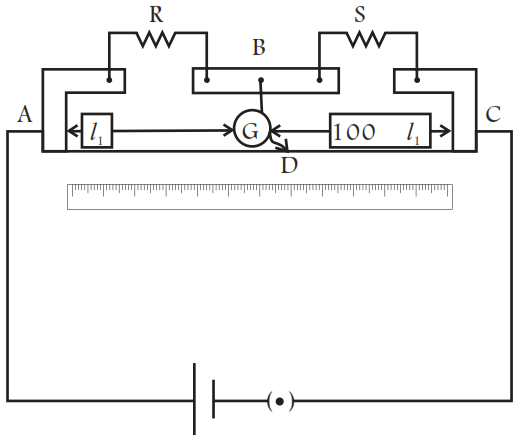
In a meter bridge the point D is a neutral point (Fig).

  • A
    The meter bridge can have no other neutral point for this set of resistances.
  • B
    When the jockey contacts a point on meter wire left of D, current flows to B from the wire.
  • C
    When the jockey contacts a point on the meter wire to the right of D, current flows from B to the wire through galvanometer.
  • D
    When R is increased, the neutral point shifts to left

Answer

  1. The meter bridge can have no other neutral point for this set of resistances.
  1. When the jockey contacts a point on the meter wire to the right of D, current flows from B to the wire through galvanometer.

Solution:

Key concept: Meter bridge: In case of meter bridge, the resistance wire AC is 100cm long. Varying the position of tapping point B, bridge is balanced. If in balanced position of bridge AB = l, BC = (100 - l) so that $\frac{\text{Q}}{\text{P}}=\frac{(100-\text{I})}{\text{I}}$. Also $\frac{\text{P}}{\text{Q}}=\frac{\text{R}}{\text{S}}>\text{S}=\frac{(100-\text{I})}{\text{I R}}$.

When there is no deflection in galvanometer there is no current across the galvanometer, then points B and D are at same potential. That point at which galvanometer shows no deflection is called null point, then potential at B and neutral point D are same. When the jockey contacts a point on the meter wire to the right of D, the potential drop across AD is more than potential drop across AB, which brings the potential of point D less than that of B, hence current flows from B to D in the galvanometer wire.
Need a full question paper?

Generate a complete, print-ready paper with questions like this in minutes — across 16+ boards, with answer keys.

Start Generating Free

Similar questions

If only 2% of the main current is to be passed through a galvanometer of resistance G, then the resistance of shunt will be

(a)

(b)          

(c) 50 G   

(d) 49 G

Coulomb's Law is true for:

An arbitrary shaped closed coil is made of a wire of length L and a current I ampere is flowing in it. If the plane of the coil is perpendicular to magnetic field , the force on the coil is

(a) Zero  

(b) IBL

(c) 2IBL   

(d)  

Which statement is correct

(a) N-type germanium is negatively charged and P-type germanium is positively charged

(b) Both N-type and P-type germanium are neutral

(c) N-type germanium is positively charged and P-type germanium is negatively charged

(d) Both N-type and P-type germanium are negatively charged

Two parallel wires of length 9 m each are separated by a distance 0.15 m. If they carry equal currents in the same direction and exerts a total force of 30 × 10–7 N on each other, then the value of current must be

(a) 2.5 amp 

(b) 3.5 amp

(c) 1.5 amp

(d) 0.5 amp

Consider a photon of a continuous X-ray coming from a Coolidge tube. Its energy comes from:

The capacity of an air condenser is 2.0 mF. If a medium is placed between its plates. The capacity becomes 12 mF. The dielectric constant of the medium will be

(a) 5 

(b) 4

(c) 3  

(d) 6

Two charges q1, q2 exert some amount of force on each other. What will happen to the force on q1 if another charge q3 is brought close to them?
Particle like behavior of light arises from the fact that each quanta of light has definite ...X... and a fixed value of ...Y.. just like a particle, Here, X and Y refer to?

The electric field due to an electric dipole at a distance r from its centre in axial position is E. If the dipole is rotated through an angle of 90° about its perpendicular axis, the electric field at the same point will be

(a) E 

(b) E/4

(c) E/2

(d) 2E