MCQ
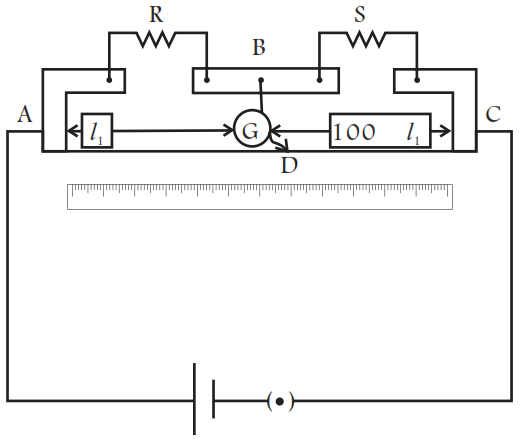
In a meter bridge the point D is a neutral point (Fig).

  • A
    The meter bridge can have no other neutral point for this set of resistances.
  • B
    When the jockey contacts a point on meter wire left of D, current flows to B from the wire.
  • C
    When the jockey contacts a point on the meter wire to the right of D, current flows from B to the wire through galvanometer.
  • D
    When R is increased, the neutral point shifts to left

Answer

  1. The meter bridge can have no other neutral point for this set of resistances.
  1. When the jockey contacts a point on the meter wire to the right of D, current flows from B to the wire through galvanometer.

Solution:

Key concept: Meter bridge: In case of meter bridge, the resistance wire AC is 100cm long. Varying the position of tapping point B, bridge is balanced. If in balanced position of bridge AB = l, BC = (100 - l) so that $\frac{\text{Q}}{\text{P}}=\frac{(100-\text{I})}{\text{I}}$. Also $\frac{\text{P}}{\text{Q}}=\frac{\text{R}}{\text{S}}>\text{S}=\frac{(100-\text{I})}{\text{I R}}$.

When there is no deflection in galvanometer there is no current across the galvanometer, then points B and D are at same potential. That point at which galvanometer shows no deflection is called null point, then potential at B and neutral point D are same. When the jockey contacts a point on the meter wire to the right of D, the potential drop across AD is more than potential drop across AB, which brings the potential of point D less than that of B, hence current flows from B to D in the galvanometer wire.
Need a full question paper?

Generate a complete, print-ready paper with questions like this in minutes — across 16+ boards, with answer keys.

Start Generating Free

Similar questions

If the source of light used in a Young's double slit experiment is changed from red to violet:

The frequency of a light ray is 6 . Its frequency when it propagates in a medium of refractive index 1.5, will be

(a) 1.67  

(b) 9.10  

(c) 6  

(d) 4  

A cube of side b  has a charge q at each of its vertices. The electric field due to this charge distribution at the centre of this cube will be

(a)  

(b)

(c)

(d) Zero

The coils of a step down transformer have 500 and 5000 turns. In the primary coil an ac of 4 ampere at 2200 volts is sent. The value of the current and potential difference in the secondary coil will be

(a) 20 A, 220 V

(b) 0.4 A, 22000 V

(c) 40 A, 220 V

(d) 40 A, 22000 V

The sensitivity of a potentiometer can be increased by:
  • increasing the series resistance in the primary circuit.
  • decreasing the length of the potentiometer wire.
  • using a thin and high resistivity wire as a potentiometer wire.
  • increasing the length of the wire.
A coil of insulating wire is connected to battery. If it is moved towards a galvanometer then its point gets deflected because.

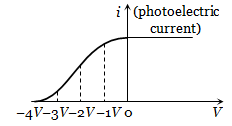
The value of stopping potential in the following diagram

(a) – 4V  

(b) – 3 V

(c) – 2V   

(d) – 1 V

The given truth table is of

(a) OR gate

(b) AND gate

(c) NOT gate

(d) None of above

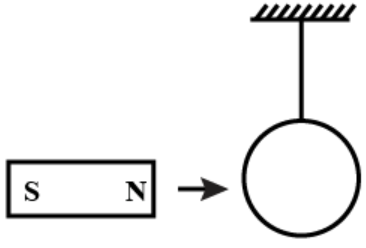
A copper ring is suspended by a thread in a vertical plane. If one end of a magnet is brought horizontally towards the ring in plane of ring as shown, the ring will.
Image

Two charges + 5μC and +10 μC are placed 20 cm apart. The net electric field at the mid-Point between the two charges is

(a) 4.5  N/C directed towards +5 μC

(b) 4.5  N/C directed towards +10 μC

(c) 13.5  N/C directed towards +5 μC

(d) 13.5  N/C directed towards +10 μC