MCQ
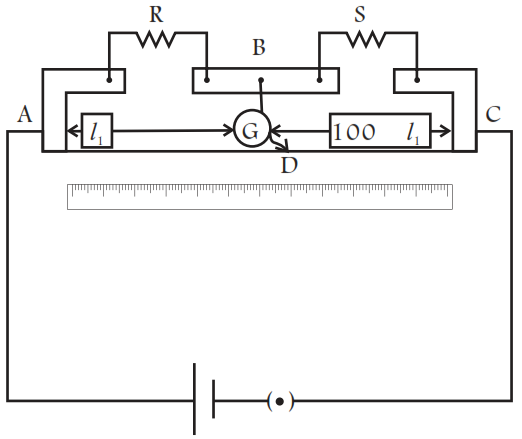
In a meter bridge the point D is a neutral point (Fig).
  • A
    The meter bridge can have no other neutral point for this set of resistances.
  • B
    When the jockey contacts a point on meter wire left of D, current flows to B from the wire.
  • C
    When the jockey contacts a point on the meter wire to the right of D, current flows from B to the wire through galvanometer.
  • A and C both.

Answer

Correct option: D.
A and C both.
Solution:
Key concept: Meter bridge: In case of meter bridge, the resistance wire AC is 100cm long. Varying the position of tapping point B, bridge is balanced. If in balanced position of bridge AB = l, BC = (100 - l) so that $\frac{\text{Q}}{\text{P}}=\frac{(100-\text{I})}{\text{I}}$. Also $\frac{\text{P}}{\text{Q}}=\frac{\text{R}}{\text{S}}>\text{S}=\frac{(100-\text{I})}{\text{I R}}$.
When there is no deflection in galvanometer there is no current across the galvanometer, then points B and D are at same potential. That point at which galvanometer shows no deflection is called null point, then potential at B and neutral point D are same. When the jockey contacts a point on the meter wire to the right of D, the potential drop across AD is more than potential drop across AB, which brings the potential of point D less than that of B, hence current flows from B to D in the galvanometer wire.

Need a full question paper?

Generate a complete, print-ready paper with questions like this in minutes — across 16+ boards, with answer keys.

Start Generating Free

Similar questions

Two solid conductors are made up of same material, have same length and same resistance. One of them has a circular cross section of area $A_{1}$ and the other one has a square cross section of area $A_{2}$. The ratio $\frac{A _{1}}{A _{2}}$ is
A potentiometer wire is $100\ cm$ long and a constant potential difference is maintained across it. Two cells are connected in series first to support one another and then in opposite direction. The balance points are obtained at $50\ cm$ and $10\ cm$ from the positive end of the wire in the two cases. The ratio of emf's is:
A $200\, W$ sodium street lamp emits yellow light of wavelength $0.6\, \mu \,m$. Assuming it to be $50\%$ efficient in converting electrical energy to light, the number of photon of yellow light it emits per second is
If three capacitors each of capacity $1\,\mu F$ are connected in such a way that the resultant capacity is $1.5\,\mu F$, then
A capacitor of capacitance $C$  is initially charged to a potential difference of $V$ $volt$. Now it is connected to a battery of $2V$ with opposite polarity. The ratio of heat generated to the final energy stored in the capacitor will be
A concave lens and a convex lens have same focal length of $20 cm$ and both put in contact this combination is used to view an object $5 cm$ long kept at $20 cm$ from the lens combination. As compared to object the image will be
A sinusoidal voltage of peak value $283\, V$ and angular frequency $320/s$ is applied to a series $LCR$ circuit. Given that $R\, = 5\,\Omega $ , $L\,= 25\, mH$ and $C\, = 1000\, \mu F$. The total impedance, and phase difference between the voltage across the source and the current will respectively be
The idea of secondary wavelets for the propagation of a wave was first given by
The dotted part of the lens is cut and kept on the $x$ axis as shown in the diagram. If parallel paraxial rays are falling on this systems then the coordinate of image  formed after refraction  from both the lenses is $(30, -1)$ . If $x = 2.5$ then $y=..........cm$ (all the distance is in cm) (Assume lens have no spherical aberration)
In an amplitude modulator circuit, the carrier wave is given by, $C(t) = 4\, sin\, (2000\,\pi t)$ while modulating signal is given by, $m(t) = 2\, sin\, (2000\, \pi t)$. The values of modulation index and lower side band frequency are