- The base-emitter junction is forward-biased.
- The base-collector junction is forward-biased.
- The base-emitter junction is reverse-biased.
- The base-collector junction is reverse-biased.
Explanation:
In the normal operation of a transistor, the base−emitter junction is forward biassed and the base−collector junction is reverse biassed. This is done so that the conduction of majority carriers can take place across the emitter−base junction and the free electrons can reach the collector to give the output current.
Generate a complete, print-ready paper with questions like this in minutes — across 16+ boards, with answer keys.
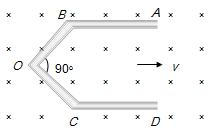
A conductor ABOCD moves along its bisector with a velocity of 1 m/s through a perpendicular magnetic field of 1 wb/m2, as shown in fig. If all the four sides are of 1m length each, then the induced emf between points A and D is

|
(a) 0 |
(b) 1.41 volt |
(c) 0.71 volt |
(d) None of the above |
The time period of a freely suspended magnet is 2 sec. If it is broken in length into two equal parts and one part is suspended in the same way, then its time period will be
| (a) 4 sec | (b) 2 sec |
(c) |
(d) 1 sec |
The nature of binding for a crystal with alternate and evenly spaced positive and negative ions is
|
(a) Covalent |
(b) Metallic |
(c) Dipolar |
(d) Ionic |
At any instant the ratio of the amount of radioactive substances is 2 : 1. If their half lives be respectively 12 and 16 hours, then after two days, what will be the ratio of the substances
|
(a) 1 : 1 |
(b) 2 : 1 |
(c) 1 : 2 |
(d) 1 : 4 |
The ratio of the frequencies of the long wavelength limits of Lyman and Balmer series of hydrogen spectrum is
|
(a) 27 : 5 |
(b) 5 : 27 |
(c) 4 : 1 |
(d) 1 : 4 |