MCQ
In a nuclear fission reaction
  • A
    Two light nuclei combine to produce a heavier nucleus
  • B
    A light nucleus bombarded by thermal neutrons breaks up
  • A heavy nucleus bombarded by thermal neutrons breaks up
  • D
    A heavy nucleus breaks up by itself

Answer

Correct option: C.
A heavy nucleus bombarded by thermal neutrons breaks up
c
(c)

Need a full question paper?

Generate a complete, print-ready paper with questions like this in minutes — across 16+ boards, with answer keys.
Start Generating Free

Similar questions

In a capacitor of capacitance 20 μF, the distance between the plates is 2mm. If a dielectric slab of width 1mm and dielectric constant 2 is inserted between the plates, then the new capacitance is
A paramagnetic material has $10^{28}\,atoms/m^3.$ Its magnetic susceptibility at temperature $350\,K$ is $2.8 \times 10^{-4}.$ Its susceptibility at $300\,K$ is
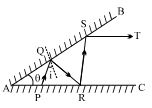
Two plane mirror $AB$ and $AC$ are inclined at an angle $\theta = 20^o$.$ A$ ray of light starting from point $P$ is incident at point $Q$ on the mirroe $AB$, then at $R$ on mirror $AC$ and again on $S$ on $AB$ finally the ray $ST$ goes parallel to mirror $AC$. The angle iwhich the ray makes with the normal at point $Q$ on mirror $AB$ is
Field lines are shown close together where the
In Milikan’s experiment, an oil drop having charge $q$ gets stationary on applying a potential difference $V$ in between two plates separated by a distance $‘d’$. The weight of the drop is
A long solenoid has a radius a and number of turns per unit length n. If it carries a current i, then the magnetic field on its axis is directly proportional to:
Frequency of $L-C$ circuit is $f_{1} .$ If a resistance $R$ is also added to
it, the frequency becomes $f_{2}$. The ratio of $\frac{f_{2}}{f_{1}}$ will be
The amplification factor of a triode is 20 and trans-conductance is 3 milli mho and load resistance $3 \times 10^4 \Omega$, then the voltage gain is
A coil of inductance $300\, mH$ and resistance $2\Omega $ is connected to a source of voltage $2V$. The current reaches half of its steady state value in....$s$
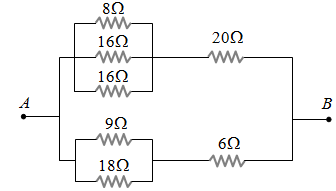
The equivalent resistance of the arrangement of resistances shown in adjoining figure between the points A and B is