MCQ
In a $p-n$ junction with open ends:
  • A
    There is a constant electric field near the junction.
  • B
    Holes and conduction electrons systematically go from the $p-$side to the $n-$side and from the n side to the $p-$side respectively.
  • C
    There is no net charge transfer between the two sides.
  • All of the above

Answer

Correct option: D.
All of the above
Because of the difference in the concentration of charge carriers in the $p−n$ junction, holes from the $p$ side move to the $n$ side and electrons from the $n$ side move to the $p$ side. This motion of charge carriers gives rise to diffusion current.
Because of this, a negative space charge region is formed in the $p$ region and a positive space region is formed in the $n$ region. This sets up an electric field across the junction. Thus, there is a constant electric field near the junction.
This electric field further opposes the diffusion of majority charge carriers across the junction. As a result, an electron from the $p$ region starts moving to the $n$ region and a hole from the $n$ region starts moving to the $p$ region. This sets up drift current. Thus, there is a systematic flow of charge carriers across the junction. Also, there is no net charge transfer between the two sides.

Need a full question paper?

Generate a complete, print-ready paper with questions like this in minutes — across 16+ boards, with answer keys.

Start Generating Free

Similar questions

A particle moves along a straight line as $s = u(t - 2) + a(t - 2)^2$
Cooking gas containers are kept in a lorry moving with uniform speed. The temperature of the gas molecules inside will
A constant torque of $1000\; Nm$ turns a wheel of moment of inertia $200 \;kgm ^{2}$ about an axis through its centre. The wheel is at rest initially. Its angular velocity after $3\; s$ is
An object is thrown along a direction inclined at an angle of ${45^o}$ with the horizontal direction. The horizontal range of the particle is equal to
Consider $a$ one-dimensional collision that involves $a$ body of mass $m_1$ originally moving in the positive $x$ direction with speed $v_0$ colliding with a second body of mass $m_2$ originally at rest. The collision could be completely inelastic, with the two bodies sticking together, completely elastic, or somewhere in between. After the collision, $m_1$ moves with velocity $v_1 $ while $m_2$ moves with velocity $v_2$.

$(A)$ $If \,m_1 > m_2$,

$(B)$ $If\, m_1 < m_2$,

An empty vessel is partially filled with water, then the frequency of vibration of air column in the vessel
Three objects colored black, gray and white can withstand hostile conditions upto $2800\,^oC$. These objects are thrown into a furnace where each of them attains a temperature of $2000\,^oC$. Which object will glow brightest?
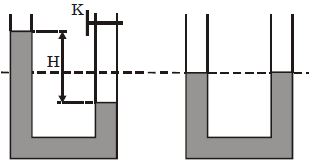
A $U$ -tube of small and uniform cross section contains water of total length $4H$. The height difference between the water columns on the left and on the right is $H$ when the valve $K$ is closed. The valve is suddenly open, and water is flowing from left to right. Ignore friction. The speed of water when the heights of the left and the right water columns are the same, is :-
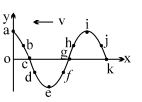
The figure represents the instantaneous picture of a longitudinal harmonic wave travelling along the negative $x$-axis. Identify the correct statement $(s)$ related to the movement of the points shown in the figure. The points moving in the direction of wave are
A small metal sphere of radius $a$ is falling with a velocity $v$ through a vertical column of a viscous liquid. If the coefficient of viscosity of the liquid is $\eta $ , then the sphere encounters an opposing force of