Question

In a P-type semiconductor

(a) Current is mainly carried by holes

(b) Current is mainly carried by electrons

(c) The material is always positively charged

(d) Doping is done by pentavalent material

Answer

(a) Current is mainly carried by holes

Need a full question paper?

Generate a complete, print-ready paper with questions like this in minutes — across 16+ boards, with answer keys.

Start Generating Free

Similar questions

In the Young’s double slit experiment, for which colour the fringe width is least

(a) Red   

(b) Green

(c) Blue   

(d) Yellow

A negatively charged plate has charge density of 2 . The initial distance of an electron which is moving toward plate, cannot strike the plate, if it is having energy of 200 eV

(a) 1.77 mm

(b) 3.51 mm

(c) 1.77 cm

(d) 3.51 cm

A group of bright and faint stars is called

(a) Galaxy

(b) Comet

(c) Black hole

(d) Constellation

For a given thermocouple, the thermo e.m.f. can be

(a) Zero  

(b) Positive

(c) Negative

(d) All of the above

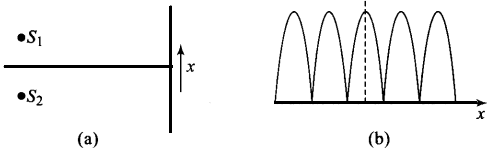
Two source S1 and S2 of intensity I1 and I2 are placed in front of a screen [Fig. (a)]. The patteren of intensity distribution seen in the central portion is given by Fig. (b).

In this case which of the following statements are true.

A diffraction is obtained by using a beam of red light. What will happen if the red light is replaced by the blue light

(a) Bands will narrower and crowd full together

(b) Bands become broader and further apart

(c) No change will take place

(d) Bands disappear

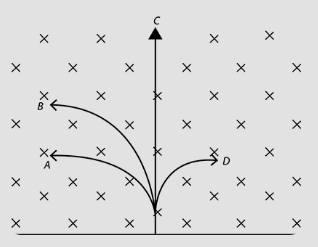
A neutron, a proton, an electron and an α−particle enter a region of uniform magnetic field with equal velocities. The magnetic field is perpendicular to the plane of paper and directed into it. The tracks of particles are labeled in the figure. The neutron follows the track:

de-Broglie wavelength of a body of mass 1 kg moving with velocity of 2000 m/s is

(a) 3.32 × 10⁻²⁷ Å

(b) 1.5 × 10⁷ Å

(c) 0.55 × 10⁻²² Å

(d) None of these

Drift velocity  varies with the intensity of electric field as per the relation

(a)  

(b)  

(c)  constant

(d)

Compton effect shows that

(a) X-rays are waves

(b) X-rays have high energy

(c) X-rays can penetrate matter

(d) Photons have momentum