MCQ
In a parallel plate capacitor, the capacity increases if:
- AArea of the plate is decreased.
- BDistance between the plates is increases.
- CArea of the plate is increased.
- DDielectric constant decreases.
Explanation:
Hint:- Check the dependence of capacitance on certain quantities.
In a parallel plate capacitor, the capacitance is $\text{C}=\frac{\text{k}\in_0\text{A}}{\text{d}};$
Where, k is the dielectric constant, $\in_0$ is the permittivity constant, A is the area of the conduction and d is the distance between plates.
From here we can see C is directly proportional to k, $\in_0$,A and inversely proportional to d.
Generate a complete, print-ready paper with questions like this in minutes — across 16+ boards, with answer keys.
In Young’s double slit experiment, distance between two sources is 0.1 mm. The distance of screen from the sources is 20 cm. Wavelength of light used is 5460 Å. Then angular position of the first dark fringe is
|
(a) 0.08° |
(b) 0.16° |
(c) 0.20° |
(d) 0.313° |
The diagram shows the path of four a-particles of the same energy being scattered by the nucleus of an atom simultaneously. Which of these are/is not physically possible
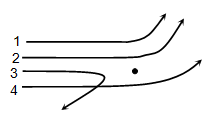
|
(a) 3 and 4 |
(b) 2 and 3 |
(c) 1 and 4 |
(d) 4 only |
Assertion : NAND or NOR gates are called digital building blocks.
Reason : The repeated use of NAND (or NOR) gates can produce all the basic or complicated gates.
|
(a) If both assertion and reason are true and the reason is the correct explanation of the assertion. |
|
(b) If both assertion and reason are true but reason is not the correct explanation of the assertion. |
|
(c) If assertion is true but reason is false. |
|
(d) If the assertion and reason both are false. |
In a good conductor the energy gap between the conduction band and the valence band is
|
(a) Infinite |
(b) Wide |
(c) Narrow |
(d) Zero |