Question
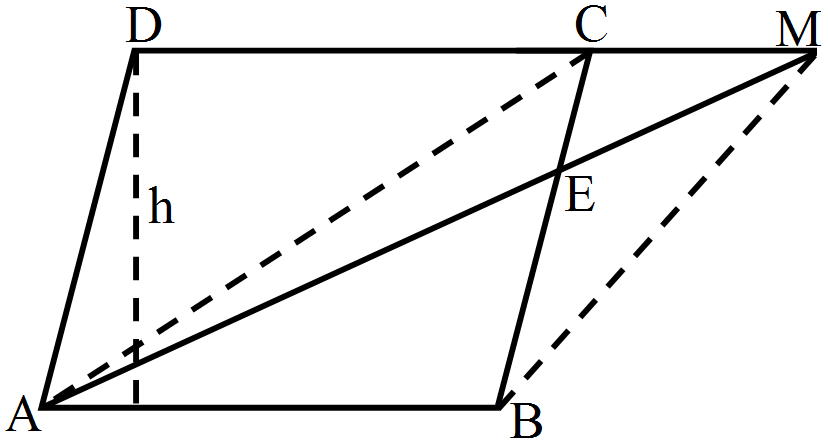
In a parallelogram $\text{ABCD},$ any point $E$ is taken on the side $\text{BC. AE}$ and $DC$ when produced meet at a point $M.$ Prove that $\text{ar}(\triangle\text{ADM})=$ ar $(\text{ABMC}).$
Answer

Construction: Join $AC$ and $BM$
Let $h$ be the distance between $AB$ and $CD$.

$\text{A}(\triangle\text{ACD})=\frac{1}{2}\times\text{CD}\times\text{h}$
$\text{A}(\triangle\text{ABM})=\frac{1}{2}\times\text{AB}\times\text{h}$
$=\frac{1}{2}\times\text{CD}\times\text{h} [AB = CD,$ opposite sides of $\|^m \text{ABCD}]$
$\Rightarrow\ \text{A}(\triangle\text{ABM})=\text{A}(\triangle\text{ACD})$
$\Rightarrow\ \text{A}(\triangle\text{ABM})+\text{A}(\triangle\text{ACM})=\text{A}(\triangle\text{ACD})+\text{A}(\triangle\text{ACM})$
$\Rightarrow\ \text{A}(\text{ABMC})=\text{A}(\triangle\text{ADM})$

Need a full question paper?

Generate a complete, print-ready paper with questions like this in minutes — across 16+ boards, with answer keys.
Start Generating Free