Question
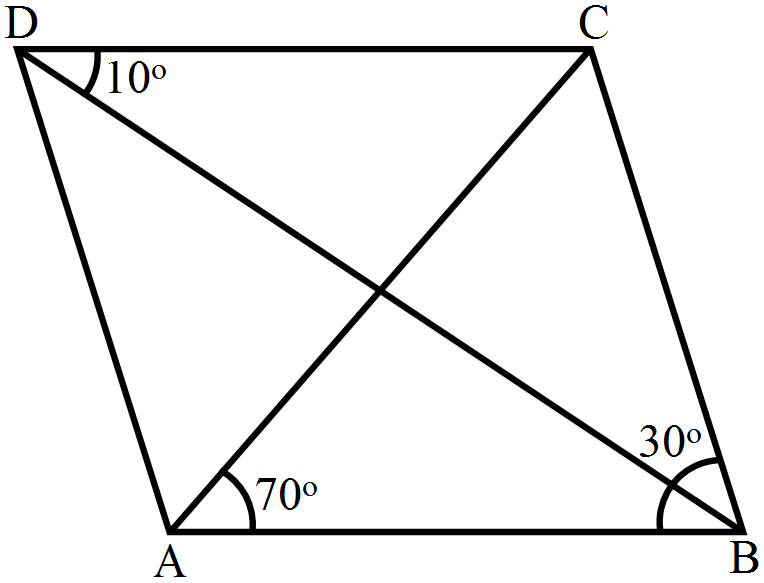
In a parallelogram ABCD, the diagonals bisect each other at O. If $\angle\text{ABC}=30^\circ$, $\angle\text{BDC}=10^\circ$ and $\angle\text{CAB}=70^\circ$.
Find: $\angle\text{DAB},\angle\text{ADC},\angle\text{BCD},\angle\text{AOD},\angle\text{DOC},\angle\text{BOC}\\\angle\text{AOB},\angle\text{ACD},\angle\text{CAB},\angle\text{ADB},\angle\text{ACB},\angle\text{DBC}\\\text{and}\ \angle\text{DBA.}$
Answer


In parallelogram ABCD, diagonal AC and ED bisect each other at O.
$\angle\text{ABC}=30^\circ$, $\angle\text{CAB}=70^\circ$ and $\angle\text{BDC}=10^\circ$
$\angle\text{ADC}=\angle\text{ABC}=30^\circ$ (Opposite angles)
and $\angle\text{ADB}=\angle\text{ADC}-\angle\text{BDC}$
$30^\circ-10^\circ=20^\circ$
AB || DC and AC is the transversal
$\angle\text{ACD}=\angle\text{CAB}=70^\circ$ (Alternate angles)
AB || DC and BD is transversal
$\angle\text{CDB}=\angle\text{ABD}=10^\circ$ (Altemate angles)
In $\triangle\text{ABC}$
$\angle\text{CAB}+\angle\text{ABC}+\angle\text{BCA}=180^\circ$ (Sum of anlges of a triangle)
$\Rightarrow70^\circ+30^\circ+\angle\text{BCA}=180^\circ$
$\Rightarrow100^\circ+\angle\text{BCA}=180^\circ$
$\angle\text{BCA}=180^\circ-100^\circ$
$\angle\text{BCA}=80^\circ$
$\angle\text{BCD}=\angle\text{BCA}+\angle\text{ACD}=80^\circ+70^\circ$
$\angle\text{BCD}=150^\circ$
$\angle\text{BCD}=\angle\text{DAB}$ (Opposite angles)
$\angle\text{DAB}=150^\circ$ and
$\angle\text{CAD}=150^\circ-70^\circ$
$\angle\text{CAD}=80^\circ$
In $\triangle\text{OCD}$,
$\angle\text{ODC}+\angle\text{OCD}+\angle\text{COD}=180^\circ$ (Angles of a triangle)
$\Rightarrow\angle\text{ACD}+\angle\text{ACD}+\angle\text{COD}=180^\circ$
$\Rightarrow70^\circ+10^\circ+\angle\text{COD}=180^\circ$
$\Rightarrow80^\circ+\angle\text{COD}=180^\circ$
$\Rightarrow\angle\text{COD}=180^\circ-80^\circ$
$\angle\text{COD}=100^\circ$
But $\angle\text{AOD}+\angle\text{COD}=180^\circ$ (Linear pair)
$\Rightarrow\angle\text{AOD}+100^\circ=180^\circ$
$\Rightarrow\angle\text{AOD}=180^\circ-100^\circ$
$\Rightarrow\angle\text{AOD}=80^\circ$
But $\angle\text{AOB}=\angle\text{COD}$
and $\angle\text{BOC}=\angle\text{AOD}$ (Vertically opposite angles)
$\angle\text{AOB}=100^\circ$ and $\angle\text{BOC}=80^\circ$
Hence,
$\angle\text{DAB}=150^\circ$, $\angle\text{ADC}=30^\circ$, $\angle\text{BCD}=150^\circ$
$\angle\text{AOD}=80^\circ$, $\angle\text{DOC}=100^\circ$
$\angle\text{BOC}=80^\circ$, $\angle\text{AOB}=100^\circ$
$\angle\text{ACD}=70^\circ$, $\angle\text{CAB}=70^\circ$, $\angle\text{AD}=20^\circ$,
$\angle\text{ACB}=80^\circ$, $\angle\text{DBC}=20^\circ$, $\angle\text{DBA}=10^\circ$

Need a full question paper?

Generate a complete, print-ready paper with questions like this in minutes — across 16+ boards, with answer keys.

Start Generating Free

Similar questions

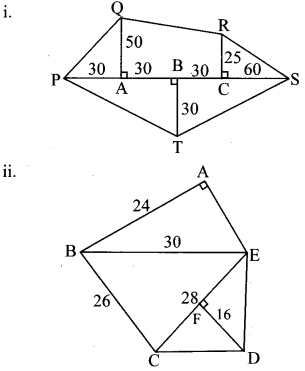
Find the areas of given plots. (All measures are in meters.)
Image
The weights of new born babies (in kg) in a hospital on a particular day are as follows:
2.3, 2.2, 2.1, 2.7, 2.6, 3.0, 2.5, 2.9, 2.8, 3.1, 2.5, 2.8, 2.7, 2.9, 2.4.
  1. Rearrange the weights in descending order.
  2. Determine the highest weight.
  3. Determine the lowest weight.
  4. Determine the range.
  5. How many babies were born on that day?
  6. How many babies weigh below 2.5 kg?
  7. How many babies weigh more than 2.8 kg?
  8. How many babies weigh 2.8 kg?
f V is the volume of the cuboid of dimensions a, b, c and S its the surface area then prove that:
$\frac{1}{\text{V}}=\frac{2}{\text{S}}\Big(\frac{1}{\text{a}}+\frac{1}{\text{b}}+\frac{1}{\text{c}}\Big)$
Observe the following pattern,
$1=\frac{1}{2}\{1\times(1+1)\}$
$1+2=\frac{1}{2}\{2\times(2+1)\}$
$1+2+3=\frac{1}{2}\{3\times(3+1)\}$
$1+2+3+4=\frac{1}{2}\{4\times(4+1)\}$
and find the values of each of the following:
  1. $1+2+3+4+5+\ .....\ +50$
  2. $31+32+\ ...\ +50$
The runs scored by two teams A and B in first 10 overs are given below:
Overs: I II III IV V VI VII VIII IX X
Team A: 2 1 8 9 4 5 6 10 6 2
Team B: 5 6 2 10 5 6 3 4 8 10
Draw a graph depicting the data, making the graphs on the same axes in each case in two different ways as a graph and as a bar chart.
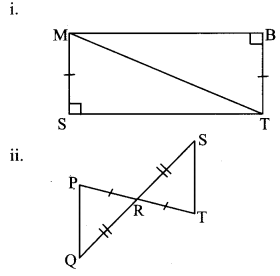
In each pair of triangles given below, parts shown by identical marks are congruent. State the test and the one-to-one correspondence of vertices by which triangles in each pair are congruent. Also state the remaining congruent parts.

Image
Image

Draw a square WXYZ with side 5.2 cm.
Number of workshops organized by a school in different areas during the last five years are as follows:
Year No. of workshops
1995-1996 25
1996-1997 30
1997-1998 42
1998-1999 50
1999-2000 65
Draw a histogram representing the above data.
Find the following product and verify the result for $x=-1, y=-2$ :
$\left(x^2 y-1\right)\left(3-2 x^2 y\right)$
The weekly wages (in Rs.) of 30 workers in a factory are given:
830, 835, 890, 810, 835, 836, 869, 845, 898, 890, 820, 860, 832, 833, 855, 845, 804, 808, 812, 840, 885, 835, 835, 836, 878, 840, 868, 890, 806, 840
Mark a frequency table with intervals as 800-810, 810-820 and so on, using tally marks. Also, draw a histogram and answer the following questions:
  1. Which group has the maximum number of workers?
  2. How many workers earn Rs. 850 and more?
  3. How many workers earn less than Rs. 850?