MCQ
In a permanent magnet at room temperature.
  • A
    Magnetic moment of each molecule is zero.
  • B
    The individual molecules have non-zero magnetic moment which are all perfectly aligned.
  • C
    Domains are partially aligned.
  • D
    Domains are all perfectly aligned.

Answer

  1. Domains are all perfectly aligned.

Need a full question paper?

Generate a complete, print-ready paper with questions like this in minutes — across 16+ boards, with answer keys.

Start Generating Free

Similar questions

If the distance between H and Cl in HCl molecule is 1.28 A, then the value of electric dipole moment of this molecule will be (in Coulomb-meter):
The current through a wire varies with time as $I=I_0+\alpha t$ where $I_0=20 A$ and $\alpha=3 As ^{-1}$. Find the charge that flows across a cross-section of the wire in first 10 seconds.
As the temperature of a metallic resistor is increased, the product of its resistivity and conductivity:

Molybdenum is used as a target element for production of X-rays because it is

(a) A heavy element and can easily absorb high velocity electrons

(b) A heavy element with a high melting point

(c) An element having high thermal conductivity

(d) Heavy and can easily deflect electrons

The electric field intensity at a point in vacuum is equal to:
Flux associated to a coil at any instant $t$ is $\phi=10 r^2$ $50 t+250$, then induced emf at $t =3$ is :

A calcite crystal is placed over a dot on a piece of paper and rotated, on seeing through the calcite one will be see

(a) One dot

(b) Two stationary dots

(c) Two rotating dots

(d) One dot rotating about the other

The probability of electrons to be found in the conduction band of an intrinsic semiconductor at a finite temperature

(a) Decreases exponentially with increasing band gap

(b) Increases exponentially with increasing band gap

(c) Decreases with increasing temperature

(d) Is independent of the temperature and the band gap

A convex lens

(a) Converges light rays

(b) Diverges light rays

(c) Form real images always

(d) Always forms virtual images

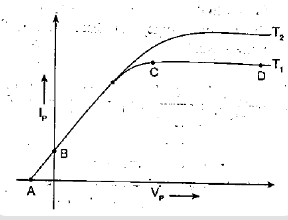
A graph of vacuum diode current Ip​, is plotted against the anode voltage Vp​ for two different temperatures T1​ and T2​ of the cathode, as shown in the figure below. Study the graph and answer the following questions.
For the same anode voltage, (called plate voltage), the current more when the cathode temperature changes from T1​ to T2​ higher temperature.