MCQ
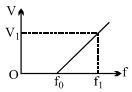
In a photoelectric experiment, the potential difference $V$ that must be maintained between the illuminated surface and the collector so as just to prevent any electron from reaching the collector is determined for different frequencies $f$ of the incident illumination. The graph obtained is shown. The maximum kinetic energy of the electrons emitted at frequency $f_1$ is 
  • A
    $hf_1$
  • B
    $\frac{{{V_1}}}{{({f_1} - {f_0})}}$
  • $h (f_1 - f_0)$
  • D
    $eV_1(f_1 - f_0)$

Answer

Correct option: C.
$h (f_1 - f_0)$
c

Need a full question paper?

Generate a complete, print-ready paper with questions like this in minutes — across 16+ boards, with answer keys.

Start Generating Free

Similar questions

The impedance of the given circuit is......$\Omega $
A thin prism of angle $15^o$ made of glass of refractive index $\mu_1  = 1.5$ is combined with another prism of glass of refractive index $\mu_2  = 1.75.$ The combination of the prisms produces dispersion without deviation. The angle of the second prism should be ......$^o$
Following is the relation between current and charge $I = A{T^2}{e^{qt/{V_L}}}$ then value of  $VL$ will be
A square loop is carrying a steady current $I$ and the magnitude of its magnetic dipole moment is $m$. If this square loop is changed to a circular loop and it carries the same current, the magnitude of the magnetic dipole moment of circular loop will be
The resistance of a galvanometer is $50\, ohms$ and the current required to give full scale deflection is $100\,\mu A$. In order to convert it into an ammeter, reading upto $10\,A$, it is necessary to put a resistance of
Select the correct statement from the following
A beam of electron is used in an YDSE experiment. The slit width is d. When the velocity of electron is increased, then
Two positively charged particles $X$ and $Y$ are initially far away from each other and at rest. $X$ begins to move towards $Y$ with some initial velocity. The total momentum and energy of the system are $p$ and $E$.
A 5℃ rise in temperature is observed in a conductor by passing a current. When the current is doubled the rise in temperature will be approximately
Two blocks each of mass $m$ lie on $a$ smooth table. They are attached to two other masses as shown in the figure. The pulleys and strings are light. An object $O$ is kept at rest on the table. The sides $AB$ & $CD$ of the two blocks are made reflecting. The acceleration of two images formed in those two reflecting surfaces $w.r.t.$ each other is: