Question
In a photoemissive cell with executing wavelength $\lambda $, the fastest electron has speed $v.$ If the exciting wavelength is changed to $\frac{{3\lambda }}{4}$, the speed of the fastest emitted electron will be

Answer

(d) $h\nu - {W_0} = \frac{1}{2}mv_{\max }^2$

$\Rightarrow \frac{{hc}}{\lambda } - \frac{{hc}}{{{\lambda _0}}} = \frac{1}{2}mv_{\max }^2$

$ \Rightarrow hc\left( {\frac{{{\lambda _0} - \lambda }}{{\lambda {\lambda _0}}}} \right) = \frac{1}{2}mv_{\max }^2$

$ \Rightarrow {v_{\max }} = \sqrt {\frac{{2hc}}{m}\left( {\frac{{{\lambda _0} - \lambda }}{{\lambda {\lambda _0}}}} \right)} $

When wavelength is $\lambda $ and velocity is $v$, then

$v = \sqrt {\frac{{2hc}}{m}\left( {\frac{{{\lambda _0} - \lambda }}{{\lambda {\lambda _0}}}} \right)} $…. $(i)$

When wavelength is $\frac{{3\lambda }}{4}$ and velocity is $v$’ then
$v' = \sqrt {\frac{{2hc}}{m}\left[ {\frac{{{\lambda _0} - (3\lambda /4)}}{{(3\lambda /4) \times {\lambda _0}}}} \right]} $….$(ii)$

Divide equation $(ii)$ by $(i)$, we get

$\frac{{v'}}{v} = \sqrt {\frac{{[{\lambda _0} - (3\lambda /4)]}}{{\frac{3}{4}\lambda {\lambda _0}}} \times \frac{{\lambda {\lambda _0}}}{{{\lambda _0} - \lambda }}} $

$v' = v{\left( {\frac{4}{3}} \right)^{1/2}}\sqrt {\frac{{[{\lambda _0} - (3\lambda /4)]}}{{{\lambda _0} - \lambda }}} $ i.e. $v' > v{\left( {\frac{4}{3}} \right)^{1/2}}$

Need a full question paper?

Generate a complete, print-ready paper with questions like this in minutes — across 16+ boards, with answer keys.
Start Generating Free

Similar questions

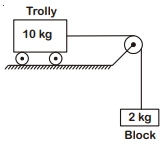
Calculate the acceleration (In $m/s^{2}$) of the block and trolly system shown in the figure. The coefficient of kinetic friction between the trolly and the surface is $0.05 .\left( g =10\; m / s ^{2},\right.$ mass of the string is negligible and no other friction exists).
A transverse wave travels on a taut steel wire with a velocity of ${v}$ when tension in it is $2.06 \times 10^{4} \;\mathrm{N} .$ When the tension is changed to $T$. the velocity changed to $\frac v2$. The value of $\mathrm{T}$ is close to
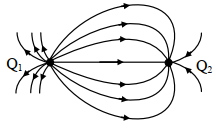
A few electric field lines for a system of two charges $Q_1$ and $Q_2$ fixed at two different points on the $\mathrm{x}$-axis are shown in the figure. These lines suggest that $Image$

$(A)$ $\left|Q_1\right|>\left|Q_2\right|$

$(B)$ $\left|Q_1\right|<\left|Q_2\right|$

$(C)$ at a finite distance to the left of $\mathrm{Q}_1$ the electric field is zero

$(D)$ at a finite distance to the right of $\mathrm{Q}_2$ the electric field is zero
An object is projected upwards with a velocity of $100 \,m/s$. It will strike the ground after (approximately)........$sec$
Carbon $ - 14$ decays with half-life of about $5,800\, years$. In a sample of bone, the ratio of carbon $ - 14$ to carbon $ - 12$ is found to be $\frac{1}{4}$ of what it is in free air. This bone may belong to a period about $x$ centuries ago, where $x$ is nearest to
A seconds pendulum clock has a steel wire. The clock shows correct time at $25^{\circ} C$. .......... $s$ time does the clock lose or gain, in one week, when the temperature is increased to $35^{\circ} C$ ? $\left(\alpha_{\text {toel }}=1.2 \times 10^{-5} /{ }^{\circ} C \right)$
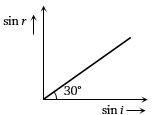
A medium shows relation between $i $ and $r$ as shown. If speed of light in the medium is $nc$ then value of $n $ is
A particle performing $SHM$ is found at its equilibrium at $t = 1\,sec$. and it is found to have a speed of $0.25\,m/s$ at $t = 2\,sec$. If the period of oscillation is $6\,sec$. Calculate amplitude of oscillation
The speed of electrons in a scanning electron microscope is $1 \times 10^{7} \,ms ^{-1}$. If the protons having the same speed are used instead of electrons, then the resolving power of scanning proton microscope will be changed by a factor of:
Assertion: A double convex lens $(\mu = 1.5)$ has focal length $10\,cm$. When the lens is immersed in water $(\mu = 4/3)$ its focal length becomes $40\,cm$

Reason: $\frac{1}{f} = \frac{{{\mu _1} - {\mu _m}}}{{{\mu _m}}} \left( {\frac{1}{{{R_1}}} - \frac{1}{{{R_2}}}} \right)$