MCQ
In a photoemissive cell with executing wavelength $\lambda $, the fastest electron has speed $v.$ If the exciting wavelength is changed to $\frac{{3\lambda }}{4}$, the speed of the fastest emitted electron will be
  • A
    $v\;{(3/4)^{1/2}}$
  • B
    $v\;{(4/3)^{1/2}}$
  • C
    $ < v\;{(4/3)^{1/2}}$
  • $ > v\;{(4/3)^{1/2}}$

Answer

Correct option: D.
$ > v\;{(4/3)^{1/2}}$
d
(d) $h\nu - {W_0} = \frac{1}{2}mv_{\max }^2$

$\Rightarrow \frac{{hc}}{\lambda } - \frac{{hc}}{{{\lambda _0}}} = \frac{1}{2}mv_{\max }^2$

$ \Rightarrow hc\left( {\frac{{{\lambda _0} - \lambda }}{{\lambda {\lambda _0}}}} \right) = \frac{1}{2}mv_{\max }^2$

$ \Rightarrow {v_{\max }} = \sqrt {\frac{{2hc}}{m}\left( {\frac{{{\lambda _0} - \lambda }}{{\lambda {\lambda _0}}}} \right)} $

When wavelength is $\lambda $ and velocity is $v$, then

$v = \sqrt {\frac{{2hc}}{m}\left( {\frac{{{\lambda _0} - \lambda }}{{\lambda {\lambda _0}}}} \right)} $…. $(i)$

When wavelength is $\frac{{3\lambda }}{4}$ and velocity is $v$’ then
$v' = \sqrt {\frac{{2hc}}{m}\left[ {\frac{{{\lambda _0} - (3\lambda /4)}}{{(3\lambda /4) \times {\lambda _0}}}} \right]} $….$(ii)$

Divide equation $(ii)$ by $(i)$, we get

$\frac{{v'}}{v} = \sqrt {\frac{{[{\lambda _0} - (3\lambda /4)]}}{{\frac{3}{4}\lambda {\lambda _0}}} \times \frac{{\lambda {\lambda _0}}}{{{\lambda _0} - \lambda }}} $

$v' = v{\left( {\frac{4}{3}} \right)^{1/2}}\sqrt {\frac{{[{\lambda _0} - (3\lambda /4)]}}{{{\lambda _0} - \lambda }}} $ i.e. $v' > v{\left( {\frac{4}{3}} \right)^{1/2}}$
Need a full question paper?

Generate a complete, print-ready paper with questions like this in minutes — across 16+ boards, with answer keys.

Start Generating Free

Similar questions

The slope of frequency of incident light and stopping potential graph for a given surface will be
${10^{ - 3}}amp$ is flowing through a resistance of $1000\,\Omega $. To measure the correct potential difference, the voltmeter is to be used of which the resistance should be
If both the plates of a charged capacitor are connected with a wire then:
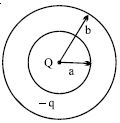
 Aspherical shell with an inner radius $'a'$ and an outer radius $'b' $ is made of conducting material. A point charge $+Q$ is placed at the centre of the spherical shell and a total charge $- q $ is placed on the shell.

Charge $- q $ is distributed on the surfaces as

The curve between current $(i)$ and potential difference $(V)$ for a photo cell will be
A carrier wave of peak voltage $14\,V$ is used for transmitting a message signal. The peak voltage of modulating signal given to achieve a modulation index of $80\%$ will be.......$V$
Assertion : The photoelectrons produced by a monochromatic light beam incident on a metal surface, have a spread in their kinetic energies.
Reason : The work function of the metal varies as a function of depth from the surface.
The capacitor of capacitance $4\,\mu F$ and $6\,\mu F$ are connected in series. A potential difference of $500\;volts$ is applied to the outer plates of the two capacitor system. The potential difference across the plates of capacitor of $4\,\mu F$ capacitance is.........$volts$
The ratio of radii of nuclei $13^{\mathrm{Al}^{27}}$ and $52^{x^A}$ is 3 : 5. The number of neutrons in the nuclei of X will be
$_{90}^{232}Th$ an isotope of thorium decays in ten stages emitting six  $\alpha$-particles and four $\beta$-particles in all. The end product of the decay is