MCQ
In a photon-particle collision, the quantity that does not remain conserved is:
- ATotal energy.
- BTotal momentum.
- CNumber of photons.
- DNone of these.
Generate a complete, print-ready paper with questions like this in minutes — across 16+ boards, with answer keys.
The emf of a battery is 2 V and its internal resistance is 0.5 W. The maximum power which it can deliver to any external circuit will be
|
(a) 8 Watt |
(b) 4 Watt |
(c) 2 Watt |
(d) None of the above |
The minimum energy required to remove an electron is called
|
(a) Stopping potential |
(b) Kinetic energy |
(c) Work function |
(d) None of these |
Cathode rays are produced when the pressure is of the order of
|
(a) 2 cm of Hg |
(b) 0.1 cm of Hg |
(c) 0.01 mm of Hg |
(d) 1 μm of Hg |
The mass number of a nucleus is equal to the number of
|
(a) Electrons it contains |
(b) Protons it contains |
|
(c) Neutrons it contains |
(d) Nucleons it contains |
$\text{F}=\frac{\text{K.}(\text{q}_1\times\text{q}_2)}{\text{r}^2}$
This is given by which law?The output current versus time curve of a rectifier is shown in the figure. The average value of the output current in this case is
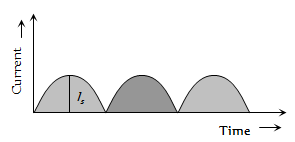
|
(a) 0 |
(b) i0/p |
(c) 2i0/p |
(d) i0 |