MCQ
In a photon$-$particle collision, the quantity that does not remain conserved is:
  • A
    Total energy.
  • B
    Total momentum.
  • Number of photons.
  • D
    None of these.

Answer

Correct option: C.
Number of photons.

Need a full question paper?

Generate a complete, print-ready paper with questions like this in minutes — across 16+ boards, with answer keys.
Start Generating Free

Similar questions

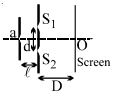
The figure shows a schematic diagram showing the arrangement of Young's Double Slit Experiment Choose the correct statement $(s)$ related to the wavelength of light used
Which among the following is false?
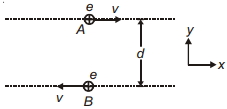
Two protons $A$ and $B$ move parallel to the $x$-axis in opposite directions with equal speeds $v$. At the instant shown, the ratio of magnetic force and electric force acting on the proton $A$ is ( $c=$ speed of light in vacuum)
When $100\, V\, DC$ is applied across a solenoid a current of $1\, A$ flows in it. When $100\, V\, AC$ is applied across the same coil, the current drops to $0.5\, A$. If the frequency of the $AC$ source is $50\,Hz$, the impedance and inductance of the solenoid are:
Radio waves and visible light in vacuum have
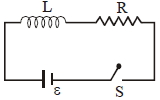
A shown in the figure, a battery of $emf \;\varepsilon$ is connected to an inductor $L$ and resistance $R$ in series. The switch is closed at $t=0 .$ The total charge that flows from the battery, between $\mathrm{t}=0$ and $\mathrm{t}=\mathrm{t}_{\mathrm{c}}\;( \mathrm{t}_{\mathrm{c}}$ is the time constant of the circuit) is
Myopia is due to
The distance between an object and the screen is $80\, cm$. A lens produces an image on the screen when the lens is placed at either of the positions $20\, cm$ apart. Focal length of the lens is.......$cm$
X-rays are produced in X-ray tube operating at a given accelerating voltage. The wavelength of the continuous X-rays has values from
Two small balls having the same mass and charge and located on the same vertical at heights $h_1$ and $h_2$ are thrown in the same direction along the horizontal at the same velocity $v$ . The first ball touches the ground at a distance $I$ from the initial vertical. At what height $H _2$ will the second ball be at this instant ? The air drag and the effect of the charges induced on the ground should be neglected.