Question
In a plane electromagnetic wave, the electric field oscillates sinusoidally at a frequency of $2.0 \times 10^{10} $Hz and amplitude $48\ V\ m^{-1}.$
  1. What is the wavelength of the wave?
  2. What is the amplitude of the oscillating magnetic field?
  3. Show that the average energy density of the E field equals the average energy density of the B field. $[c = 3 \times 10^8\ m\ s^{-1}.]$
Answer

Frequency of the electromagnetic wave, $ν = 2.0 \times 10^{10} Hz$
Electric field amplitude, $E_0 = 48 V m^{-1}$
Speed of light, $c = 3 \times 10^8 m/ s$​​​​​​​
  1. Wavelength of a wave is given as:
$\lambda=\frac{\text{c}}{\text{v}}$
$=\frac{3\times10^8}{2\times10^{10}}=0.015 \ \text{m}$
  1. Magnetic field strength is given as:
$\text{B}_0=\frac{\text{E}_0}{\text{c}}$
$=\frac{48}{3\times10^{8}}=1.6\times10^{-7}\ \text{T}$
  1. Energy density of the electric field is given as:
$\text{U}_E=\frac{1}{2}\in_0\text{E}^2$
And, energy density of the magnetic field is given as:
$\text{U}_\text{B}=\frac{1}{2\mu_0}\text{B}^2$
Where, $\in_0$ = Permittivity of free space
$\mu_0$ = Permeability of free space
We have the relation connecting E and B as:
E = cB … (1)
Where,
$\text{c}=\frac{1}{\sqrt{\in_0 \ \mu_0}}\dots(2)$
Putting equation (2) in equation (1), we get
$\text{E}=\frac{1}{\sqrt{\in_0 \ \mu_0}}\text{B}$
Squaring both sides, we get
$\text{E}^2=\frac{1}{\in_0\ \mu_0}\text{B}^2$
$\in_0\text{E}^2=\frac{\text{B}^2}{\mu_0}$
$\frac{1}{2}\in_0\text{E}^2=\frac{1}{2}\frac{\text{B}^2}{\mu_0}$
$\Rightarrow \ \text{U}_\text{E}=\text{U}_\text{B}$

Need a full question paper?

Generate a complete, print-ready paper with questions like this in minutes — across 16+ boards, with answer keys.

Start Generating Free

Similar questions

A narrow beam of singly-charged carbon ions, moving at a constant velocity of $6.0 \times 10^4m s^{-1}$, is sent perpendicularly in a rectangular region of uniform magnetic field B = 0.5T It is found that two beams emerge from the field in the backward direction, the separations from the incident beam being 3.0cm and 3.5cm. Identify the isotopes present in the ion beam. Take the mass of an ion $= A(1.6 \times 10^{-27})kg$, where A is the mass number.
A bar magnet of length 1cm and cross-sectional area $1.0cm^2$ produces a magnetic field of $1.5 \times 10.$ T at a point in end-on position at a distance 15cm away from the centre.
  1. Find the magnetic moment M of the magnet.
  2. Find the magnetization I of the magnet.
  3. Find the magnetic field B at the centre of the magnet.
A professor reads a greeting card received on his 50th birthday with +2.5D glasses keeping the card 25cm away. Ten years later, he reads his farewell letter with the same glasses but he has to keep the letter 50cm away. What power of lens should he now use?
Four particles having masses m, 2m, 3m and 4m are placed at the four corners of a square of edge a. Find the gravitational force acting on a particle of mass m placed at the centre.
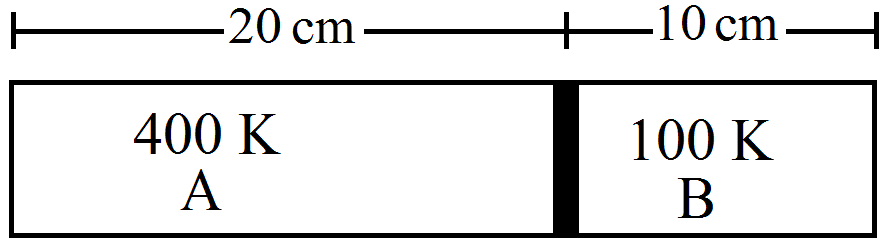
Figure. shows a cylindrical tube of length 30cm which is partitioned by a tight-fitting separator. The separator is very weakly conducting and can freely slide along the tube. Ideal gases are filled in the two parts of the vessel. In the beginning, the temperatures in the parts A and B are 400K and 100K respectively. The separator slides to a momentary equilibrium position shown in the figure. Find the final equilibrium position of the separator, reached after a long time.
A stone is thrown vertically upward with a speed of 28m/s.
  1. Find the maximum height reached by the stone.
  2. Find its velocity one second before it reaches the maximum height.
  3. Does the answer of part.
  4. Change if the initial speed is more than 28m/s suchas 40m/s or 80m/s?
A charged particle of charge e and mass m is moving in an electric field E and magnetic field B. Construct dimensionless quantities and quantities of dimension $[T]^{-1}$^.
A 600pF capacitor is charged by a 200V supply. It is then disconnected from the supply and is connected to another uncharged 600 pF capacitor. How much electrostatic energy is lost in the process?
A $100\mu\text{F}$ capacitor is joined to a 24V battery through a $1.0\text{M}\Omega$ resistor. Plot qualitative graphs (a) between current and time for the first 10 minutes and (b) between charge and time for the same period.
What are coherent sources of light? Why are coherent sources required to produce interference of light? Give an example of interference in everyday life.