Question
In a plot of photoelectric current versus anode potential, how does?

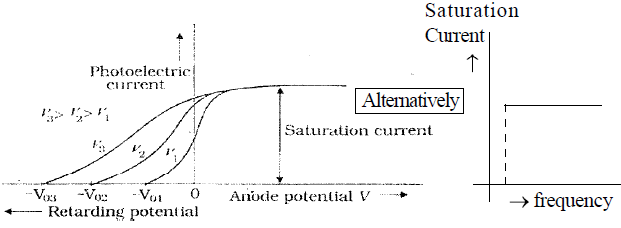
  1. The saturation current vary with anode potential for incident radiations of different frequencies but same intensity?
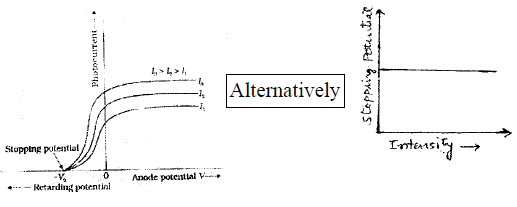
  2. The stopping potential vary for incident radiations of different intensities but same frequency?
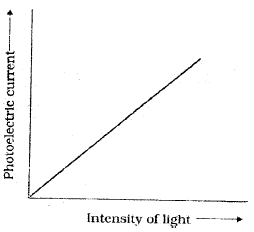
  3. Photoelectric current vary for different intensities but same frequency of incident radiations?

Justify your answer in each case.
Answer

  1. Saturation current does not change.

  1. stopping potential does not change.

  1. Photoelectric current increases with increase in intensity.


Need a full question paper?

Generate a complete, print-ready paper with questions like this in minutes — across 16+ boards, with answer keys.

Start Generating Free

Similar questions

  1. Using Bohr's second postulate of quantization of orbital angular momentum show that the circumference of the electron in the nth orbital state in hydrogen atom is n times the de Broglie wavelength associated with it.
  2. The electron in hydrogen atom is initially in the third excited state.What is the maximum number of spectral lines which can be emitted when it finally moves to the ground state?
Can X-rays be used for photoelectric effect?
Describe the working principle of a moving coil galvanometer. Why is it necessary to use (i) a radial magnetic field and (ii) a cylindrical soft iron core in a galvanometer? Write the expression for current sensitivity of the galvanometer.
Can a galvanometer as such be used for measuring the current? Explain.
We are given the following atomic masses:
$\begin{array}{l}{ }_{92}^{238} U=238.05079 u \\
{ }_2^4 H e=4.00260 u \\
{ }_{90}^{234} Th =234.04363 u \\
{ }_1^1 H=1.00783 u \\
{ }_{91}^{237} Pa=237.05121 u \end{array}$
Here the symbol Pa is for the element protactinium (Z = 91).
i. Calculate the energy released during the alpha decay of ${ }_{92}^{238} U$.
ii. Calculate the kinetic energy of the emitted $\alpha$-particles.
iii. Show that ${ }_{92}^{238} U$ can not spontaneously emit a proton.
A ball is dropped from a height. If it takes 0.200s to cross the last 6.00m before hitting the ground, find the height from which it was dropped. Take g = 10m/s2.
Three capacitors of capacitance 2 pF, 3 pF and 4 pF are connected in parallel.
(a) What is the total capacitance of the combination?
(b) Determine the charge on each capacitor if the combination is connected to a 100 V supply.
C1 = 2 pF
= 2 X 10 -12 F
C2 = 3 pF
3 X 10 -12 F
C3 = 4 pF
= 4 X 10-12 F
A rod of mass m and length L, lying horizontally, is free to rotate about a vertical axis through its centre. A horizontal force of constant magnitude F acts on the rod at a distance of $\frac{\text{L}}{4}$ from the centre. The force is always perpendicular to the rod. Find the angle rotated by the rod during the time (t) after the motion starts.
A solid sphere rolling on a rough horizontal surface with a linear speed v collides elastically with a fixed, smooth, vertical wall. Find the speed of the sphere after it has started pure rolling in the backward direction.
A particle moves in a circle of diameter 1.0cm under the action of a magnetic field of 0.40T. An electric field of 200 Vm-1 makes the path straight. Find the charge/ mass ratio of the particle.
In a silicon transistor, the base current is changed by $20\mu\text{A}.$ This results in a change of 0.02V in base to emitter voltage and a change of 2mA in the collector current.
  1. Find the input resistance, $\beta-$ac and trans conductance of the transistor.
  2. This transistor is used as an amplifier in CE configuration with a load resistance $5\text{k}\Omega$ What is the voltage gain of the amplifier?