Question

In a PN-junction

(a) P and N both are at same potential

(b) High potential at N side and low potential at P side

(c) High potential at P side and low potential at N side

(d) Low potential at N side and zero potential at P side

Answer

(b) High potential at N side and low potential at P side

Need a full question paper?

Generate a complete, print-ready paper with questions like this in minutes — across 16+ boards, with answer keys.

Start Generating Free

Similar questions

Which metal is used to make ferromagnets ?
Wheatstones’s bridge cannot be used for measurement of very _______ resistances.
An airplane with wingspan 50m is flying horizontally with a speed of 360kmhr-1 over a place where the vertical component of the earth's magnetic field is 2×10⁻². The potential difference between the tips of the wings would be

Two wires A and B of same material and mass have their lengths in the ratio 1 : 2. On connecting them to the same source, the rate of heat dissipation in B is found to be 5W. The rate of heat dissipation in A is

(a) 10W  

(b) 5W

(c) 20W   

(d) None of these

The Lenz's law is based on which of the following physical quantity?
The radius of a circle is stated as 2.12cm. Its area should be written as:
  1. 14cm2.
  2. 14.1cm2.
  3. 14.11cm2.
  4. 14.1124cm2.

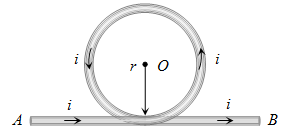
A part of a long wire carrying a current i is bent into a circle of radius r as shown in figure. The net magnetic field at the centre O of the circular loop is

(a)  

(b)  

(c)

(d)

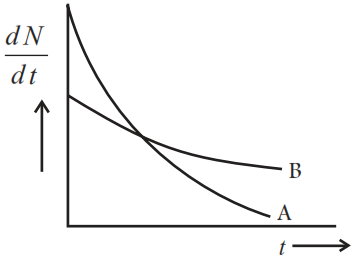
The variation of decay rate of two radioactive samples A and B with time is shown in Fig. Which of the following statements are true?

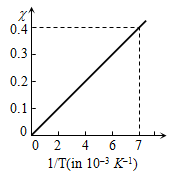
The X – 1/T graph for an alloy of paramagnetic nature is shown in Fig. The curie constant is, then

(a) 57 K

(b) 2.8  

(c) 570 K 

(d) 17.5  

Light rays from a source are incident on a glass prism of index of refraction μ and angle of prism α. At near normal incidence, the angle of deviation of the emerging rays is

(a) (μ – 2)α

(b) (μ – 1) α

(c) (μ + 1) α

(d) (μ + 2) α