MCQ
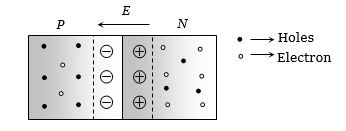
In a $PN-$ junction diode not connected to any circuit
  • A
    The potential is the same everywhere
  • B
    The $ P-$ type is a higher potential than the $N-$ type side
  • There is an electric field at the junction directed from the $N-$  type side to the $ P- $ type side
  • D
    There is an electric field at the junction directed from the $P-$ type side to the $N-$type side
Answer

Correct option: C.
There is an electric field at the junction directed from the $N-$  type side to the $ P- $ type side
c
(c)At junction a potential barrier/depletion layer is formed, with $N-$ side at higher potential and $ P- $ side at lower potential. Therefore there is an electric field at the junction directed from the $N-$ side to $P-$ side
 

Need a full question paper?

Generate a complete, print-ready paper with questions like this in minutes — across 16+ boards, with answer keys.

Start Generating Free

Similar questions

As the temperature of hot junction increases, the thermo e.m.f.
One conducting $U$ tube can slide inside another as shown in figure, maintaining electric contacts between the tubes. The magnetic field $B$ is perpendicular to the plane of the figure. If each tube moves towards the other at a constant speed $v$, then the emf induced in the circuit in terms of $B, l $ and $v$ where $l$ is the width of each tube, will be
One of the refractive surfaces of a prism of angle $30^o$ is silvered.Aray of light incident at an angle of $60^o$ retraces it path. The refractive index of the material of prism is :
If the dipole with charges $\pm q$ are kept perpendicular to each other inside a closed cube, then the total electric flux emerging out of the cube will be:
Three capacitances of capacity$10\,\mu F,\;5\,\mu F$ and $5\,\mu F$ are connected in parallel. The total capacity will be........$\mu F$
At a point $A$ on the earth's surface the angle of $\operatorname{dip}, \delta=+25^{\circ} .$ At a point $B$ on the earth's surface the angle of dip, $\delta=-25^{\circ} .$ We can interpret that
The extreme wavelengths of Paschen series are
Young’s double slit experiment is performed with light of wavelength $550 \,nm$. The separation between the slits is $1.10\, mm$ and screen is placed at distance of $1 \,m$. What is the distance between the consecutive bright or dark fringes.........$mm$
In the circuit shown, the current through the $4\,\Omega $ resistor is $1\, amp$ when the points $P$ and $M$ are connected to a d.c. voltage source. The potential difference between the points $M$ and $N$ is ............... $volt$
A Hydrogen-like atom has atomic number $Z$. Photons emitted in the electronic transitions from level $n=4$ to level $n=3$ in these atoms are used to perform photoelectric effect experiment on a target metal. The maximum kinetic energy of the photoelectrons generated is $1.95 \mathrm{eV}$. If the photoelectric threshold wavelength for the target metal is $310 \mathrm{~nm}$, the value of $Z$ is. . . . . . .[Given: $h c=1240 \mathrm{eV}-\mathrm{nm}$ and $R h c=13.6 \mathrm{eV}$, where $R$ is the Rydberg constant, $h$ is the Planck's constant and $c$ is the speed of light in vacuum]