Question
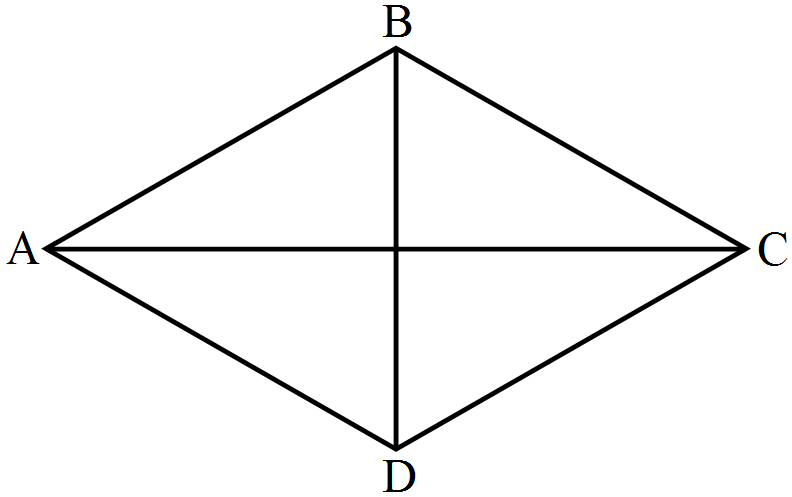
In a quadrilateral ABCD, show that (AB + BC + CD + DA) > (AC + BD).
Answer

Given: Quadrilateral ABCD To prove: (AB + BC + CD + DA) > (AC + BD) Proof: In $\triangle\text{ABC},$$\text{AB + BC > AC }...(\text{i})$
In $\triangle\text{CAD},$$\text{CD + AD > AC }...(\text{ii})$
In $\triangle\text{BAD,}$$\text{AB + AD + BD } ...(\text{iii})$
In $\triangle\text{BCD},$$\text{BC + CD + BD }...(\text{iv})$
Adding (i), (ii), (iii) and (iv), we get$2(\text{AB + BC + CD + DA})< 2 \text{(AC + BD)}$
Hence, $\text{(AB + BC + CD + DA)}<(\text{AC + BD}).$

Need a full question paper?

Generate a complete, print-ready paper with questions like this in minutes — across 16+ boards, with answer keys.
Start Generating Free

Similar questions

Observe the information shown in pairs of triangles given below. State the test by which the two triangles are congruent. Write the remaining congruent parts of the triangles.
Each side of a rhombus is 10cm long and one of its diagonals measures 16cm. Find the length of the other diagonal and hence find the area of the rhombus.
Write any three rational numbers between the two numbers given below.
i. 0.3 and – 0.5
ii. – 2.3 and – 2.33
iii. 5.2 and 5.3
iv. – 4.5 and – 4.6
In a triangle ABC, if L and M are points on AB and AC respectively such that LM || BC. Prove that:
  1. $\text{ar}(\triangle\text{LCM})=\text{ar}(\triangle\text{LBM})$
  2. $\text{ar}(\triangle\text{LBC})=\text{ar}(\triangle\text{MBC})$
  3. $\text{ar}(\triangle\text{ABM})=\text{ar}(\triangle\text{ACL})$
  4. $\text{ar}(\triangle\text{LOB})=\text{ar}(\triangle\text{MOC})$
Prove the Theorem : Congruent chords of a circle are equidistant from the centre of the circle.
The total number of lions and peacocks in a certain zoo is 50. The total number of their legs is 140. Then find the number of lions and peacocks in the zoo.
In Q.No. 1, if AD = 6cm, CF = 10cm, and AE = 8cm, find AB.
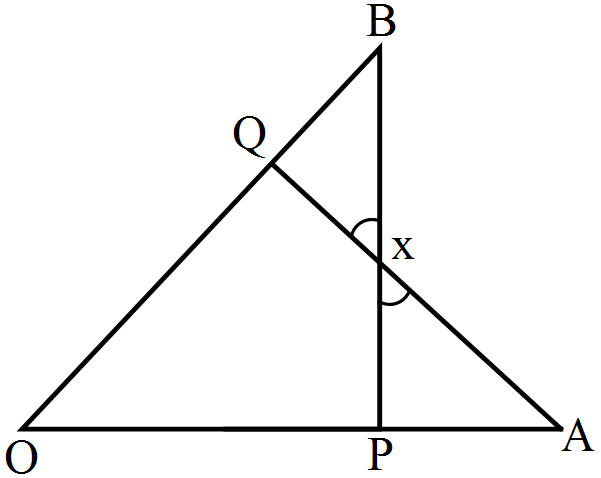
In the given figure, OA = OB and OP = OQ. Prove that (i) PX = QX, (ii) AX = BX.
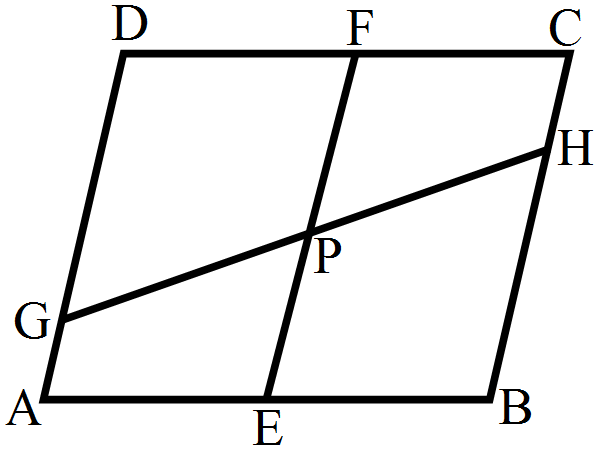
In the adjoining figure, ABCD is a || gm in which E and F are the midpoints of AB and CDrespectively. If GH is a line segment that cuts AD, EF and BC at G, P and H respectively, prove that GP = PH.
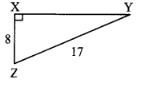
In right angled $\triangle Y X Z, \angle X=90^{\circ}, X Z=8 cm, Y Z=17 cm$, find $\sin Y, \cos Y, \tan Y, \sin Z, \cos Z, \tan Z$.
Image