Question
In a Quincke's experiment the sound detected is changed from a maximum to a minimum when the sliding tube is moved through a distance of 2.50cm. Find the frequency of sound if the speed of sound in air is 340m/s.

Answer

Distance between tow maximum to a minimum is given by, $\frac{\lambda}{4}=2.50\text{cm}$$\Rightarrow\lambda=10\text{cm}=10^{-1}\text{m}$
We know, V = nx$\Rightarrow\text{n}=\frac{\text{V}}{\lambda}=\frac{340}{10^{-1}}$
$=3400\text{Hz}$
$=3.4\text{KHz}$

Need a full question paper?

Generate a complete, print-ready paper with questions like this in minutes — across 16+ boards, with answer keys.
Start Generating Free

Similar questions

Answer the following: You are given a thread and a metre scale. How will you estimate the diameter of the thread?
State few important uses of the phenomenon of beats.
In which of the following examples of motion, can the body be considered approximately a point object: A monkey sitting on top of a man cycling smoothly on a circular track.
A single lens is mounted in a tube. A parallel beam enters the tube and emerges out of the tube as a divergent beam. Can you say with certainty that there is a diverging lens in the tube?
A steel wire has a length of 12.0m and a mass of 2.10kg. What should be the tension in the wire so that the speed of transverse wave on the wire equals the speed of sound in dry air at 20°C? Take the speed of sound at 20°C = 343m/s.
Is a 'single isolated force' possible in nature?
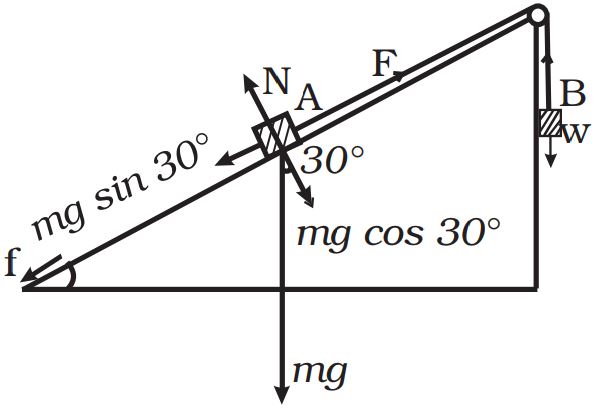
Block A of weight 100N rests on a frictionless inclined plane of slope angle 30° A flexible cord attached to A passes over a frictonless pulley and is connected to block B of weight W. Find the weight W for which the system is in equilibrium.
Example 5.4 In a ballistics demonstration a police officer fires a bullet of mass $50.0 g$ with speed $200 m s ^{-1}$ (see Table 5.2) on soft plywood of thickness $2.00 cm$. The bullet emerges with only $10 \%$ of its initial kinetic energy. What is the emergent speed of the bullet?
A 1cm object is placed perpendicular to the principal axis of a convex mirror of focal length 7.5cm. Find its distance from the mirror if the image formed is 0.6cm in size.
Find the number of molecules of an ideal gas in a volume of $1.000cm^3a$ at STP.