MCQ
In a radioactive decay process, the activity is defined as $A=-\frac{\mathrm{d} N}{\mathrm{~d} t}$, where $N(t)$ is the number of radioactive nuclei at time $t$. Two radioactive sources, $S_1$ and $S_2$ have same activity at time $t=0$. At a later time, the activities of $S_1$ and $S_2$ are $A_1$ and $A_2$, respectively. When $S_1$ and $S_2$ have just completed their $3^{\text {rd }}$ and $7^{\text {th }}$ half-lives, respectively, the ratio $A_1 / A_2$ is. . . . . . .
  • A
    $10$
  • B
    $12$
  • C
    $15$
  • $16$

Answer

Correct option: D.
$16$
d
$S_1  S_2$

$\mathrm{t}=0 \quad \mathrm{~A}_0 \quad \mathrm{~A}_0$

$t=\tau \quad A_1 \quad A_2$

$\frac{\mathrm{A}_1}{\mathrm{~A}_2}=\frac{\mathrm{A}_0(0.5)^{t /\left(L_{r i}\right)_2}}{\mathrm{~A}_0(0.5)^{t /\left(t_{\mu z}\right)_2}}=\frac{(0.5)^3}{(0.5)^7}=2^4=16$

Need a full question paper?

Generate a complete, print-ready paper with questions like this in minutes — across 16+ boards, with answer keys.

Start Generating Free

Similar questions

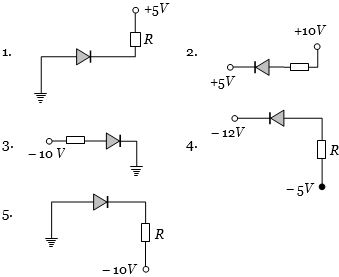
In the given figure, which of the diodes are forward biased ?.
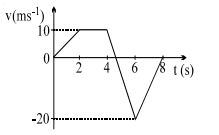
 The figure shows a velocity-time graph of a particle moving along a straight line. The particle comes to rest at $t=$ ....... $\sec$
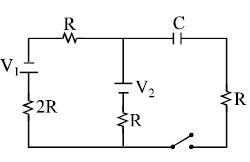
In the transient current circuit shown, the time constant is
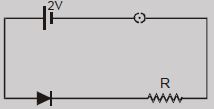
A $2\,V$ battery forward biases a diode. There is a drop of $0.5\,V$ across the diode which is independent of current. Also a current greater then $10\,mA$ produces large joule heat and damages diode. If diode is to be operated at $5\,mA,$ the series resistance to be put is
The time period of a satellite of earth is $5\, hours$. If the separation between the centre of earth and the satellite is increased to $4\, times$ the previous value, the new time period will become ....... $h$
The instantaneous values of alternating current and voltages in a circuit are given as 

$ I= \frac{1}{{\sqrt 2 }} sin \left( {100\pi t} \right)$  

$E=\frac{1}{\sqrt{2}} \sin (100 \pi t+\pi / 3)$

The average power in watts consumed in the circuit is

Water falls from a height of $60\, \mathrm{~m}$ at the rate of $15 \,\mathrm{~kg} / \mathrm{s}$ to operate a turbine. The losses due to frictional force are $10\, \%$ of the input energy. How much power is generated by the turbine? $\left(g=10\, \mathrm{~m} / \mathrm{s}^{2}\right)$  (In $\mathrm{~kW}$)
Which among the following, is a form of energy
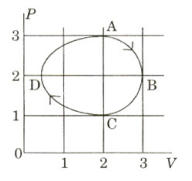
The figure shows the $P-V$ plot of an ideal gas taken through a cycle $ABCDA$. The part $ABC$ is a semi-circle and $CDA$ is half of an ellipse. Then,

$(A)$ the process during the path $\mathrm{A} \rightarrow \mathrm{B}$ is isothermal

$(B)$ heat flows out of the gas during the path $\mathrm{B} \rightarrow \mathrm{C} \rightarrow \mathrm{D}$

$(C)$ work done during the path $\mathrm{A} \rightarrow \mathrm{B} \rightarrow \mathrm{C}$ is zero

$(D)$ positive work is done by the gas in the cycle $ABCDA$

Two wires of same metal have the same length but their cross-sections are in the ratio $3:1$. They are joined in series. The resistance of the thicker wire is $10\,\Omega $. The total resistance of the combination will be ............. $\Omega$