MCQ
In a radioactive decay process , the negatively charged emitted $\beta -$ particles are
  • A
    the electrons orbiting around the nucleus
  • B
    the electrons produced as a result of collisions between atoms
  • the electrons produced as a result of the decay of neautrons inside the nucleus
  • D
    the electrons present inside the nucleus
Answer

Correct option: C.
the electrons produced as a result of the decay of neautrons inside the nucleus
c
In beta minus decay $\left(\beta^{-}\right),$ a neutron is transformed into a proton and an electron is emitted with the nucleus along with an antineutrino.

$n \rightarrow p+e^{-}+\bar{v}$

where $\bar{v}$ is the antineutrino

Need a full question paper?

Generate a complete, print-ready paper with questions like this in minutes — across 16+ boards, with answer keys.

Start Generating Free

Similar questions

A moving coil galvanometer has $N$ number of turns in a coil of effective area $A$, it carries a current $I$. The magnetic field $B$ is radial. The torque acting on the coil is
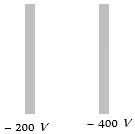
In the following figure two parallel metallic plates are maintained at different potential. If an electron is released midway between the plates, it will move
Rising and setting sun appears to be reddish because :
Cathode rays are similar to visible light rays in that
The potential energy function for the force between two atoms in a diatomic molecule is approximately given by $U(x)=$ $\;\frac{a}{{{x^{12}}}} - \frac{b}{{{x^6}}}$ where a and b are constants and $x $ is the distance between the atoms. If the dissociation energy of the molecule is $D = [ U ( x = \infty) - U_{ at\ equilibrium}], D$ is
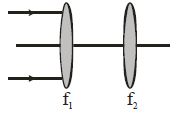
A parallel beam of light is incident on a system of two convex lenses of focal lengths $f_1 = 20\, cm$ and $f_2 = 10\, cm$. What should be the distance between the two lenses so that rays after refraction from both the lenses pass undeviated ?........$cm$
The amount of work done in blowing a soap bubble such that its diameter increases from $d$ to $D$ is ($T=$ surface tension of the solution)
The intensity of radiation emitted by the sun has its maximum value at a wavelength of $510\;nm$ and that emitted by the north star has the maximum value at $350\;nm$. If these stars behave like black bodies, then the ratio of the surface temperature of the sun and north star is
In India electricity is supplied for domestic use at $220 \,V$. It is supplied at $110 \,V$ in USA. If the resistance of a $60 \,W$ bulb for use in India is $R$, the resistance of a $60 \,W$ bulb for use in USA will be
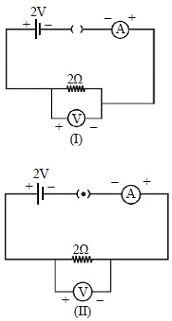
For the circuits shown in figures $I$ and $II$, the voltmeter reading would be