MCQ
In a radioactive decay process , the negatively charged emitted $\beta -$ particles are
  • A
    the electrons orbiting around the nucleus
  • B
    the electrons produced as a result of collisions between atoms
  • the electrons produced as a result of the decay of neautrons inside the nucleus
  • D
    the electrons present inside the nucleus
Answer

Correct option: C.
the electrons produced as a result of the decay of neautrons inside the nucleus
c
In beta minus decay $\left(\beta^{-}\right),$ a neutron is transformed into a proton and an electron is emitted with the nucleus along with an antineutrino.

$n \rightarrow p+e^{-}+\bar{v}$

where $\bar{v}$ is the antineutrino

Need a full question paper?

Generate a complete, print-ready paper with questions like this in minutes — across 16+ boards, with answer keys.

Start Generating Free

Similar questions

Match the List$-I$ with List$-II$.

List $I$ List $II$
$A$ $AC$ generator $I$ Presence of both $L$ and $C$
$B$ Transformer $II$ Electromagnetic Induction
$C$Resonance phenomenon to occur $III$ Quality factor
$D$Sharpness of resonance $IV$ Mutual Inductance

Choose the correct answer from the options given below:

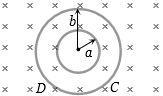
Plane figures made of thin wires of resistance $R = 50$ milli ohm/metre are located in a uniform magnetic field perpendicular into the plane of the figures and which decrease at the rate $dB/dt =\, 0.1 \,m \,T/s$. Then currents in the inner and outer boundary are. (The inner radius $a = 10 \,cm$ and outer radius $b = 20 \,cm$)
A uniform magnetic field acts at right angles to the direction of motion of electrons. As a result, the electron moves in a circular path of radius 2 cm. If the speed of the electrons is doubled, then the radius of the circular path will be
In the following transitions, which one has higher frequency
In an electron gun the control grid is given a negative potential relative to cathode in order to:
Corpuscles are the tiny particles of:
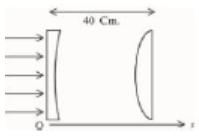
As shown in the figure, a combination of a thin plano concave lens and a thin plano convex lens is used to image an object placed at infinity. The radius of curvature of both the lenses is $30\,cm$ and refraction index of the material for both the lenses is $1.75$. Both the lenses are placed at distance of $40\,cm$ from each other. Due to the combination, the image of the object is formed at distance $x =..........cm$, from concave lens.
In a region of space having a uniform electric field $E$, a hemispherical bowl of radius r is placed. The electric flux $\phi$ through the bowl is:
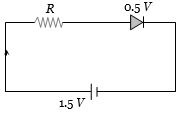
The diode used in the circuit shown in the figure has a constant voltage drop of $0.5\; V$ at all currents and a maximum power rating of $100 $ milliwatts. What should be the value of the resistor $R$, connected in series with the diode for obtaining maximum current.......$\Omega$
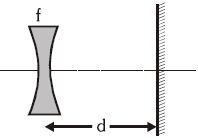
A diverging lens of focal length $10\, cm$ is placed $10\, cm$ in front of a plane mirror as shown in the figure. Light from a very far away source falls on the lens. The final image is at a distance