MCQ
In a rectangle $ABCD\,\,(BC = 2AB)$. The moment of inertia along which axis will be minimum
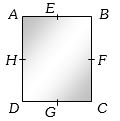
  • A
    $BC$
  • B
    $BD$
  • C
    $HF$
  • $EG$

Answer

Correct option: D.
$EG$
d
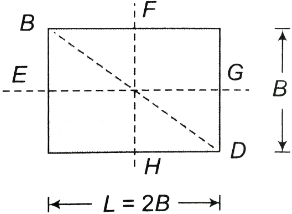
The moment of inertia will be minimum about that axis, which is passing through the center of mass.

$I_{E G}=\frac{M B^{2}}{12}$

$I_{F H}=\frac{M(2 B)^{2}}{12}=\frac{M B^{2}}{6}$

$M. I.$ of the rectangular plate about its diagonal $I_{B D}=\frac{M B^{2} L^{2}}{6\left(B^{2}+L^{2}\right)}=\frac{M B^{2} \times 4 B^{2}}{6\left(B^{2}+4 B^{2}\right)}=\frac{2}{15} M B^{2}=\frac{M B^{2}}{7.5}$

$M. I.$ about $E G$ is minimum.

$\mathrm{OR}$

By observation, distribution of mass is the nearest about axis $E G .$
Need a full question paper?

Generate a complete, print-ready paper with questions like this in minutes — across 16+ boards, with answer keys.
Start Generating Free

Similar questions

Balls are thrown vertically upward in such a way that the next ball is thrown when the previous one is at the maximum height. If the maximum height is $5m$, the number of balls thrown per minute will be
Two sine waves travel in the same direction in a medium. The amplitude of each wave is a and the phase difference between the two waves is $120^\circ.$ The resultant amplitude will be:
A resonance air column of length $20 cm$ resonates with a tuning fork of frequency $250 Hz$. The speed of sound in air is .... $m/s$
A person standing on a spring balance inside a stationary lift measures $60 \,kg$. The weight of that person if the lift descends with uniform downward acceleration of $1.8\, m / s ^{2}$ will be $_{-} N$. $\left[ g =10\, m / s ^{2}\right]$
The ends of two rods of different materials with their thermal conductivities, radii of cross-sections and lengths all are in the ratio $1:2$ are maintained at the same temperature difference. If the rate of flow of heat in the larger rod is $4\;cal/\sec $, that in the shorter rod in $cal/\sec $ will be
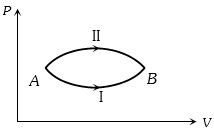
A system goes from $A$ to $B$ via two processes $I$ and $II$ as shown in figure. If $\Delta {U_1}$ and $\Delta {U_2}$ are the changes in internal energies in the processes $I$ and $II$ respectively, then
A large horizontal surface moves up and down in $S.H.M.$ with an amplitude of $1\, cm$. If a mass of $10\, kg$ (which is placed on the surface is to remain continuously in contact with it, the maximum frequency of $S.H.M.$ will be .... $Hz$
A particle has a velocity $u$ towards east at $t=0$. Its acceleration is towards west and is constant. Let $x_A$ and $x_B$ be the magnitude of displacements in the first $10$ seconds and the next $10$ seconds:
A planet has same density as that of earth and universal gravitational constant $G$ is twice that of earth, the ratio of acceleration due to gravity, is.
The displacement of a particle executing SHM is given by $x=10 \sin \left(\omega t+\frac{\pi}{3}\right) \mathrm{m}$. The time period of motion is $3.14 \mathrm{~s}$. The velocity of the particle at $\mathrm{t}=0$is_________. $\mathrm{m} / \mathrm{s}$.