In a region of space, suppose there exists a uniform electric field $\vec{E}=10 i\left(\frac{ v }{ m }\right)$. If a positive charge moves with a velocity $\vec{v}=-2 \hat{j}$, its potential energy
Easy
Download our app for free and get started
(c)
As charge moves perpendicular to $\vec{E}$, no change in energy occurs.

Download our appand get started for free
Experience the future of education. Simply download our apps or reach out to us for more information. Let's shape the future of learning together!No signup needed.*
Similar Questions
- 1How will the voltage $(V)$ between the two plates of a parallel plate capacitor depend on the distance $(d)$ between the plates, if the charge on the capacitor remains the same?View Solution
- 2An electric dipole of moment $p$ is placed in the position of stable equilibrium in uniform electric field of intensity $E$. It is rotated through an angle $\theta $ from the initial position. The potential energy of electric dipole in the final position isView Solution
- 3The plates of parallel plate capacitor are charged upto $100\;V$. A $2\,mm$ thick plate is inserted between the plates. Then to maintain the same potential difference, the distance between the plates is increased by $1.6\;mm$. The dielectric constant of the plate isView Solution
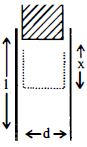
- 4A parallel plate capacitor is made of two plates of length $l$, width $w$ and separated by distance $d$. A dielectric slab ( dielectric constant $K$) that fits exactly between the plates is held near the edge of the plates. It is pulled into the capacitor by a force $F = -\frac{{\partial U}}{{\partial x}}$ where $U$ is the energy of the capacitor when dielectric is inside the capacitor up to distance $x$ (See figure). If the charge on the capacitor is $Q$ then the force on the dielectric when it is near the edge isView Solution
- 5The electric field near a conducting surface having a uniform surface charge density $\sigma $ is given byView Solution
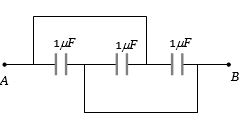
- 6The equivalent capacitance in the circuit between $A$ and $B$ will be.....$\mu \,F$View Solution
- 7Potential atapoint $A$ is $3 $ $ volt$ and atapoint $B$ is $7$ $volt$,an electron is moving towards $A$ from $B.$View Solution
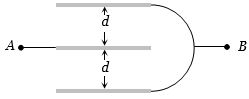
- 8Three plates of common surface area $A$ are connected as shown. The effective capacitance will beView Solution
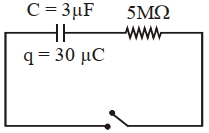
- 9The circuit shown in the figure consists of a charged capacitor of capacity $3\, \mu F$ and a charge of $30\, \mu C$. At time $t =0,$ when the key is closed, the value of current flowing through the $5\, M \Omega$ resistor is $'x'$ $\mu-A$. The value of $'x'$ to the nearest integer is .........View Solution
- 10Each plate of a parallel plate capacitor has a charge $q$ on it. The capacitor is now connected to a battery. Now,View Solution