MCQ
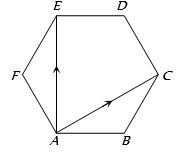
In a regular hexagon $ABCDEF$ , $\overrightarrow {AE} = $
  • A
    $\overrightarrow {AC} \,\, + \,\,\overrightarrow {AF} \,\, + \,\overrightarrow {AB} $
  • $\overrightarrow {AC} \,\, + \,\,\overrightarrow {AF} \,\, - \,\overrightarrow {AB} $
  • C
    $\overrightarrow {AC} \,\, + \,\,\overrightarrow {AB} \,\, - \,\,\overrightarrow {AF} $
  • D
    None of these

Answer

Correct option: B.
$\overrightarrow {AC} \,\, + \,\,\overrightarrow {AF} \,\, - \,\overrightarrow {AB} $
b
(b) Obviously, $\overrightarrow {AE} = \overrightarrow {AC} + \overrightarrow {CD} + \overrightarrow {DE} $

$ = \overrightarrow {AC} + \overrightarrow {AF} - \overrightarrow {AB} $, .$\left\{ {\,\because \,\,\overrightarrow {CD}  = \overrightarrow {AF} \,{\text{and}}\,\overrightarrow {DE}  =  - \overrightarrow {AB} } \right\}$  

Need a full question paper?

Generate a complete, print-ready paper with questions like this in minutes — across 16+ boards, with answer keys.

Start Generating Free

Similar questions

Let for a triangle $ABC$,

$\overline{A B}=-2 \hat{i}+\hat{j}+3 \hat{k}$

$\overline{C B}=\alpha \hat{i}+\beta \hat{j}+\gamma \hat{k}$

$\overline{C A}=4 \hat{i}+3 \hat{j}+\delta \hat{k}$

If $\delta > 0$ and the area of the triangle $ABC$ is $5 \sqrt{6}$, then $\overline{C B} \cdot \overline{C A}$ is equal to

If $f(x) = \frac{{{e^x}}}{{1 + {e^x}}},\,\,\,\;{I_1} = \int_{f( - a)}^{f(a)} {xg\{ x(1 - x)\} dx} $, and ${I_2} = \int_{f( - a)}^{f(a)} {g\{ x(1 - x))\} dx} $, then the value of $\frac{{{I_2}}}{{{I_1}}}$ is
Given $ABC$ is an equilateral triangle of side length $1$ unit and $P$ be any arbitrary point on the circumcircle of triangle $ABC,$ then $|\vec PA|^2+|\vec PB|^2+|\vec PC|^2$ is equal to 
Integrating factor of the differntial equation $\cos\text{x}\frac{\text{dy}}{\text{dx}}+\text{y}\sin\text{x}=1$is:  
  1. $\sin\text{x}$
  2. $\sec\text{x}$
  3. $\tan\text{x}$
  4. $\cos\text{x}$ 
The points A(1, 1, 0), B(0, 1, 1), C(1, 0, 1) and $\text{D}\big(\frac{2}{3},\frac{2}{3},\frac{2}{3}\big)$
  1. Coplanar
  2. Non-coplanar
  3. Vertices of a parallelogram
  4. None of these
The straigth line $\frac{\text{x}-3}{3}=\frac{\text{y}-2}{1}=\frac{\text{z}-1}{0}$ is:
If the area of the region

$\left\{(\mathrm{x}, \mathrm{y}): \frac{\mathrm{a}}{\mathrm{x}^2} \leq \mathrm{y} \leq \frac{1}{\mathrm{x}}, 1 \leq \mathrm{x} \leq 2,0<\mathrm{a}<1\right\}$ is

$\left(\log _e 2\right)-\frac{1}{7}$ then the value of $7 a-3$ is equal to:

The function $f(x) = {x^3} - 3{x^2} - 24x + 5$ is an increasing function in the interval given below
The value of $\left| {\begin{array}{*{20}{c}}
{\sin \alpha }&{\cos \alpha }&{\sin \left( {\alpha  + \gamma } \right)}\\
{\sin \beta }&{\cos \beta }&{\sin \left( {\beta  + \gamma } \right)}\\
{\sin \delta }&{\cos \delta }&{\sin \left( {\gamma  + \delta } \right)}
\end{array}} \right|$ is 
If $y =\frac{1}{{1\,\, + \,\,{x^{n\, - \,m\,}}\, + \,\,{x^{p - \,m}}}} +\frac{1}{{1\,\, + \,\,{x^{m\, - \,n\,}}\, + \,\,{x^{p - \,n}}}} +\frac{1}{{1\,\, + \,\,{x^{m\, - \,p\,}}\, + \,\,{x^{n - \,p}}}}$ then $\frac{{dy}}{{dx}}$ at  ${e^{{m^{{n^p}}}}}$ is equal to: