MCQ
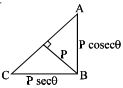
In a right angled triangle the hypotenuse is $2 \sqrt 2$ times the perpendicular drawn from the opposite vertex. Then the other acute angles of the triangle are
  • A
    $\frac{\pi }{3}$ & $\frac{\pi }{3}$
  • $\frac{\pi }{8}$ & $\frac{3 \pi }{8}$
  • C
    $\frac{\pi }{4}$ & $\frac{\pi }{4}$
  • D
    $\frac{\pi }{5}$ & $\frac{3 \pi }{10}$

Answer

Correct option: B.
$\frac{\pi }{8}$ & $\frac{3 \pi }{8}$
b
$p^2sec^2\theta + p^2cosec^2\theta ={\left( {2\sqrt 2 } \right)^2} p^2$

$\Rightarrow$ $\frac{1}{{{{\sin }^2}\theta \,{{\cos }^2}\theta }}\,\, = \,8$

$sin^22\theta = 1/2 = {\left( {\frac{1}{{\sqrt 2 }}} \right)^2}$

$2\theta = n\pi + \pi /4$

$\theta = n\pi /2 + \pi /8$

for $n = 0$      $\Rightarrow$      $\theta = \pi /8$

for $n=1$      $\Rightarrow$      $\theta = 3\pi /8$

Need a full question paper?

Generate a complete, print-ready paper with questions like this in minutes — across 16+ boards, with answer keys.

Start Generating Free

Similar questions

Let $A=\left[\begin{array}{cc}\frac{1}{\sqrt{10}} & \frac{3}{\sqrt{10}} \\ \frac{-3}{\sqrt{10}} & \frac{1}{\sqrt{10}}\end{array}\right]$ and $B =\left[\begin{array}{rr}1 & - i \\ 0 & 1\end{array}\right]$, where $i =\sqrt{-1}$. If $M = A ^{ T } BA$, then the inverse of the matrix $AM ^{2023} A ^{ T }$ is $.........$
The sum, of the coefficients of the first $50$ terms in the binomial expansion of $(1-x)^{100}$, is equal to
$\int_0^{\pi /2} {{e^x}\sin x\,dx = } $
If the radius of a circle increases from  $3 \,\, cm$ to  $3.2 \,\, cm,$ then the increase in the area of the circle is
Let $f: R \rightarrow R$ be defined as

$f(x)=\left[\begin{array}{ll}{\left[e^{x}\right],} \,\,\,\,\,\,\,\,\,\,\,\,\, \,\,\,\,\,\,\,\,\,\,\,\,\, \,\,\,\,\,\,\,x<0 \\ a e^{x}+[x-1], \,\,\,\,\,\,\,\,\,0 \leq x<1 \\ b+[\sin (\pi x)], \,\,\,\,\,\,\,\,\,\,\,\,1 \leq x<2 \\ {\left[e^{-x}\right]-c,} \,\,\,\,\,\,\,\,\,\,\,\,\, \,\,\,\,\,\,\,\,\,x \geq 2\end{array}\right.$

where a,b,c $\in R$ and $[t]$ denotes greatest integer less than or equal to $t.$ Then, which of the following statements is true $?$

If $\alpha $ and $\beta $ are solutions of $sin^2\,x + a\, sin\, x + b = 0$ as well that of $cos^2\,x + c\, cos\, x + d = 0$ , then $sin\,(\alpha + \beta )$ is equal to
If the function $g\left( x \right) = \left\{ \begin{array}{l} a{e^x},\,\,\,\,\,x \le 0\\ b\cos x + x,\,\,x > 0 \end{array} \right.\,$ is differentiable, then the value of $a^2 + b^2$ is
Let $\left(5, \frac{a}{4}\right)$, be the circumcenter of a triangle with vertices $A ( a ,-2), B ( a , 6)$ and $C \left(\frac{ a }{4},-2\right)$. Let $\alpha$ denote the circumradius, $\beta$ denote the area and $\gamma$ denote the perimeter of the triangle. Then $\alpha+\beta+\gamma$ is
$\int_0^{\pi /8} {\frac{{{{\sec }^2}2x}}{2}\,dx = } $
The value of $\mathop {\lim }\limits_{x \to 0} \frac{{{{(1 + x)}^{1/x}} - e + \frac{1}{2}ex}}{{{x^2}}}$ is