Question
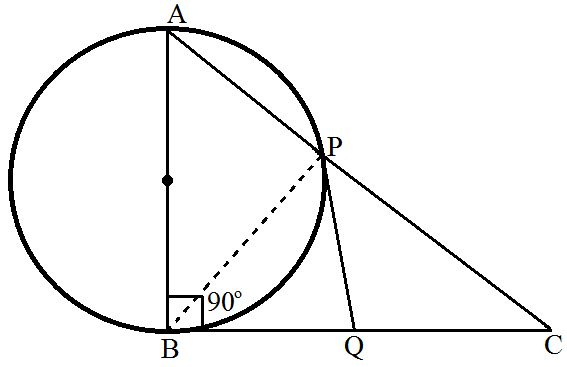
In a right triangle ABC in which $\angle\text{B}=90^{\circ},$ a circle is drawn with AB as diameter intersecting the hypotenuse AC at P. Prove that the tangent to the circle at P bisects
BC.

Answer


Given: $\triangle\text{ABC}$ is right triangle in which $\angle\text{ABC}=90^{\circ}.$ A circle is drawn with side AB as diameter intersecting AC in P.
PQ is the tangent to the circle when intersects BC in Q.
Construction: join BP.
Proof: PQ and BQ are tangents drawn from an external point Q.
⇒ PQ = BQ....(i) [Length of tangents drawn from an external point to the circle are equal]
$\Rightarrow\angle\text{PBQ}=\angle\text{BPQ}$ [In a triangle, equal side have equal angles opposite to them]
As, it is the diameter of the circle.
$\therefore\angle\text{APB}=90^{\circ}$ [Angle in a semi-circle is 90°]
$\angle\text{APB}+\angle\text{BPC}=180^{\circ}$ [Linear pair]
$\Rightarrow\angle\text{BPC}=180^{\circ}-\angle\text{APB}=180^{\circ}-90^{\circ}=90^{\circ}$
In $\triangle\text{BPC},$
$\angle\text{BPC}+\angle\text{PBC}+\angle\text{PCB}=180^{\circ}$[Angle sum property]
$\Rightarrow\angle\text{PBC}+\angle\text{PCB}=180^{\circ}-90^{\circ}=90^{\circ}...\text{(ii)}$
Now,
$\angle\text{BPC}=90^{\circ}$
$\Rightarrow\angle\text{BPQ}+\angle\text{CPQ}=90^{\circ}...\text{(iii)}$
From (ii) and (iii), we get,
$\Rightarrow\angle\text{PBC}+\angle\text{PCB}=\angle\text{BPQ}+\angle\text{CPQ}$
$\Rightarrow\angle\text{PCQ}=\angle\text{CPQ}[\angle\text{BPQ}=\angle\text{PBQ}]$
In $\triangle\text{PQC},$
$\angle\text{PCQ}=\angle\text{PQC}$
$\therefore$ PQ = QC ...(iv)
From (i) and (iv), we get,
BQ = QC
Thus, tangent at P bisects th side BC.

Need a full question paper?

Generate a complete, print-ready paper with questions like this in minutes — across 16+ boards, with answer keys.

Start Generating Free

Similar questions

The following table gives production yield per hectare of wheat of 100 farms of a village :
Production yield40-4545-5050-5555-6060-6565-70
No. of farms4616203024
Change the distribution to a 'more than' type distribution and draw its ogive.
A well of diameter 4 m is dug 14 m deep. The earth taken out is spread evenly all around the well to form a 40 cm high embankment. Find the width of the embankment.
Name the quadrilateral formed, if any, by the following points, and given reason for your answers:
A(-3, 5), B(3, 1), C(0, 3), D(-1, -4).
The length and the breadth of a rectangular garden are in the ratio 9 : 5. A path 3.5m wide, running all around inside it has an area of $1911m^2$​​​​​​​. Find the dimensions of the garden.
Determine the values of a and b so that the following system of linear equations have infinitely many solutions:
$(2a - 1)x + 3y - 5 = 0$
$3x + (b - 1)y - 2 = 0$
An aeroplane is flying at a height of 300 m above the ground. Flying at this height, the angles of depression from the aeroplane of two points on both banks of a river in opposite directions are $45^{\circ}$ and $60^{\circ}$ respectively. Find the width of the river. [Use $\sqrt{3}=1.732$ ]
AD and PM are medians of triangles ABC and PQR respectively where $\triangle ABC \sim \triangle PQR$. Prove that $\frac{A B}{P Q}=$ $\frac{A D}{P M}$.
Draw a $\triangle\text{ABC}$ in which base BC = 6cm, AB = 5cm and $\angle\text{ABC}=60^\circ.$ Then construct another triangle whose sides are of the corresponding sides of $\triangle\text{ABC}.$
Four cows are tethered at the four comers of a square field of side 50m such that each can graze the maximum unshared area. What area will be left ungrazed? $[\text{Tale }\pi=3.14]$
A train travels 180km at a uniform speed. If the speed had been 9km/hr more, it would have taken 1 hour less for the same journey. Find the speed of the train.