Question

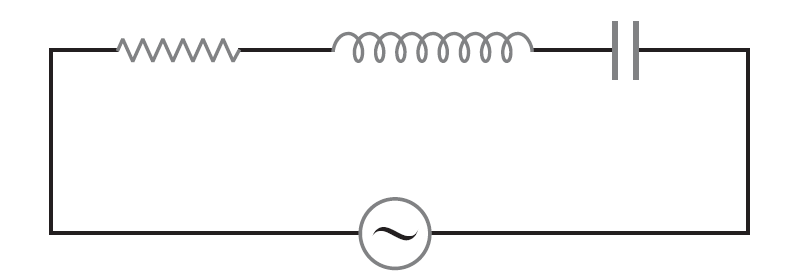
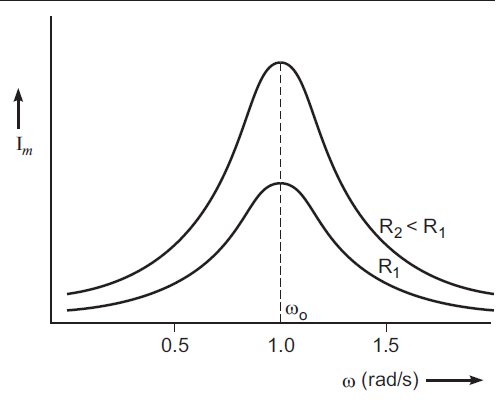
In a series LCR circuit connected to an ac source of variable frequency and voltage v vm= sin, draw a plot showing the variation of current (I) with angular frequency ($\omega$) for two different values of resistance R1 and R2(R1 > R2 ). Write the condition under which the phenomenon of resonance occurs. For which value of the resistance out of the two curves, a sharper resonance is produced? Define Q-factor of the circuit and give its significance.
Answer


At certain frequency $\omega$, the flow of current through the series combination
$\text{I}_{m} = \frac{\text{v}_{m}}{\sqrt{\text{R}^{2} + (\text{x}_{L} - \text{x}_{C}^{2}})}$
Where XL = $\omega_{L}$
and
$\text{X}_{C} = \frac{1}{\omega\text{C}}.$
Condition of resonance – If systemis (LCR) of natural frequency $\omega_{0}$ is driven by an energy source at a frequency $\omega$, the amplitude of the current flow increases, however the amplitude of the current rises to its maximum value, if frequency of the energy source becomes exactly equal to the natural frequency.
For resistance R2 < R1, series LCR shows a sharp resonance.
Q-factor – The ratio of reactance (either inductive or capacitive) at natural frequency to the resistance of the current is called Q - factor
$\text{Q} = \frac{\text{X}_{L}}{\text{R}} = \frac{\omega_{0}\text{L}}{\text{R}}$

Significance:
  1. If resistance R is low or inductance L is large then Q – factor is large and the circuit is more selective.
  2. If resonance is less sharp, tunning of the circuit will not be good.

Need a full question paper?

Generate a complete, print-ready paper with questions like this in minutes — across 16+ boards, with answer keys.

Start Generating Free

Similar questions

Explain the behaviour of non polar molecule and polar molecule in uniform electric field.
Prove that, if an insulated, uncharged conductor is placed near a charged conductor and no other conductors are present, the uncharged body must be intermediate in potential between that of the charged body and that of infinity.
A parallel-plate capacitor having plate area 25cm2 and separation 1.00mm is connected to a battery of 6.0V. Calculate the charge flown through the battery. How much work has been done by the battery during the process?
(a) What happens if a bar magnet is cut into two pieces: (i) transverse to its length, (ii) along its length?
(b) A magnetised needle in a uniform magnetic field experiences a torque but no net force. An iron nail near a bar magnet, however, experiences a force of attraction in addition to a torque. Why?
(c) Must every magnetic configuration have a north pole and a south pole? What about the field due to a toroid?
(d) Two identical looking iron bars A and B are given, one of which is definitely known to be magnetised. (We do not know which one.) How would one ascertain whether or not both are magnetised? If only one is magnetised, how does one ascertain which one? [Use nothing else but the bars A and B.]
Which waves are electromagnetic waves?Which factors are responsible for their production?
  1. Draw circuit diagram and explain the working of a zener diode as a dc voltage regulator with the help of its I-V characteristic.
  2. What is the purpose of heavy doping of p- and n-sides of a zener diode?
Is the colour of 620nm light and 780nm light same? Is the colour of 620nm light and 621nm light same? How many colours are there in white light?
A light of wavelength 6000 Å is incident on a metal of work function 2 eV. Will electrons be emitted? If yes, find maximum energy of emitted electrons.
Prove that the structure of helium and oxygen nuclei is more stable than that of deuterium nuclei.
Find the energy liberated in the reaction:
223Ra → 209Pb + 14C.
The atomic masses needed are as follows.
223Ra 209Pb 14C
22.018u 208.981u 14.003u