MCQ
In a shotput event an athlete throws the shotput of mass $10 \ kg$ with an initial speed of $1 \mathrm{~m} \mathrm{~s}^{-1}$ at $45^{\circ}$ from a height $1.5 m$ above ground. Assuming air resistance to be negligible and acceleration due to gravity to be $10 \mathrm{m} \mathrm{~s}^{-2}$, the kinetic energy of the shotput when it just reaches the ground will be:
  • A
    $20.5J$
  • B
    $5.0J$
  • C
    $52.5J$
  • $155.0J$

Answer

Correct option: D.
$155.0J$
If air resistance is negligible, total mechanical energy of the system will remain constant.
And let us take ground as a reference where potential energy will be zero.
According to the problem, $\mathrm{h}=1.5 \mathrm{~m}, \mathrm{v}=1 \mathrm{~m} / \mathrm{s}, \mathrm{m}=10 \mathrm{~kg}, \mathrm{~g}=10 \mathrm{~m} \mathrm{~s}^{-2}$
Initial energy of the shotput $=(\mathrm{PE})_{\mathrm{i}}+(\mathrm{KE})_{\mathrm{i}}$
$=\text{mgh}+\frac{1}{2}\text{mv}^2$
$=10\times10\times1.5+\frac{1}{2}\times10\times(1)^2$
$=150+5$
$=155.0\text{J}$
From conservation of mechanical energy,
$\text{(PE)}_\text{i}+\text{(KE)}_\text{i}=\text{(PE)}_\text{f}+\text{(KE)}_\text{f}$
So, final kinetic energy of the shotput is $155J$

Need a full question paper?

Generate a complete, print-ready paper with questions like this in minutes — across 16+ boards, with answer keys.

Start Generating Free

Similar questions

No work is done by a force on an object if:
An object starts $5m$ from origin and moves with an initial velocity of $5\ ms^{-1}$ and has an acceleration of $2\ ms^{-2}$. After $10\sec,$ the object is how far from the origin?
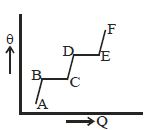
A solid cube having certain fixed melting and boiling points takes heat from some source.The variation  of temperature $\theta$ of the cube with the heat supplied $Q$ is shown in the adjoining graph. The portion $BC$ of the graph represents the conversion of
An object may have:
  1. Varying speed without having varying velocity.
  2. Varying velocity without having varying speed.
  3. Nonzero acceleration without having varying velocity.
  4. Nonzero acceleration without having varying speed.
Which of the following relations is true
Two particles $A$ and $B$ start from rest and move for equal time on a straight line. Particle $A$ has an acceleration of $2\,m / s ^2$ for the first half of the total time and $4\,m / s ^2$ for the second half. The particle $B$ has acceleration $4\,m / s ^2$ for the first half and $2\,m / s ^2$ for the second half. Which particle has covered larger distance?
The $\text{rms}$ speed of oxygen molecules in a gas is $v.$ If the temperature is doubled and the oxygen molecules dissociate into oxygen atoms, the rms speed will become:
$A$ uniform rod of mass $m$ and length $l$ hinged at its end is released from rest when it is in the horizontal position. The normal reaction at the hinge when the rod becomes vertical is :
A simple pendulum suspended from the roof of a lift oscillates with frequency $v$ when the lift is at rest. If the lift falls freely under gravity, its frequency of oscillations becomes:
The coefficient of linear expansion depends on