Question
In a simple Atwood machine, two unequal masses $m_1$ and $m_2$ are connected by a string going over a clamped light smooth pulley. In a typical arrangement $m_1 = 300g$ and $m_2 = 600g$. The system is released from rest.
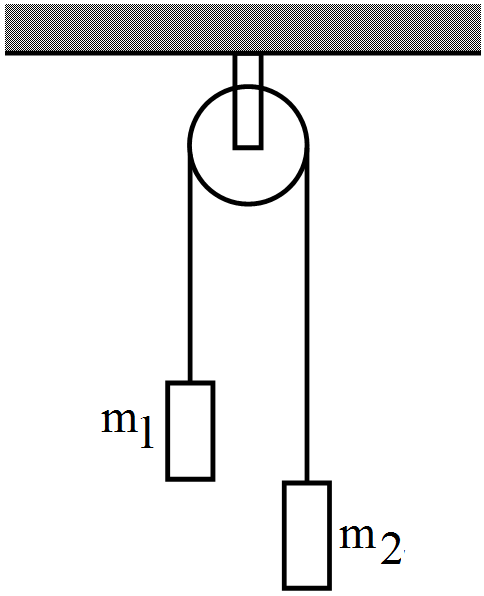
  1. Find the distance travelled by the first block in the first two seconds.
  2. Find the tension in the string.
  3. Find the force exerted by the clamp on the pulley.
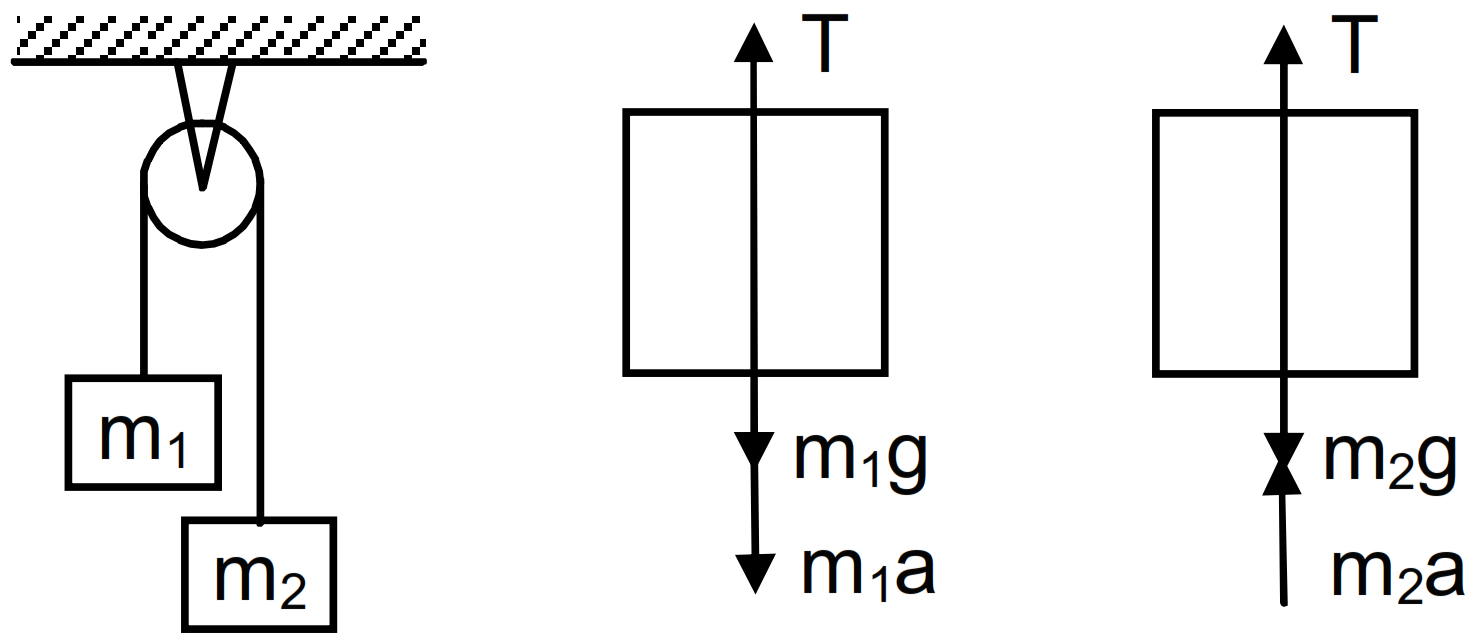
Answer


$m_1 = 0.3\ kg, m_2 = 0.6\ kg$
$T - (m_1g + m_1a) = 0 …(i)$
$\Rightarrow T = m_1g + m_1a$
$T + m_2a - m_2g = 0 …(ii)$
$\Rightarrow T = m_2g - m_2a$
From equation $(i)$ and equation $(ii)$
$m_1g + m_1a + m_2a - m_2g = 0, from (i)$
$\Rightarrow a(m_1 + m_2) = g(m_2 - m_1)$
$\Rightarrow\text{a = f}\Big(\frac{\text{m}_2-\text{m}_1}{\text{m}_1-\text{m}_2}\Big)=9.8\Big(\frac{0.6-0.3}{0.6+0.3}\Big)=3.266\text{ms}^{-2}.$
  1. $t = 2 \sec$ acceleration $= 3.266 ms^{-2}$
Initial velocity $u = 0$
So, distance travelled by the body is,
$\text{S = ut}+\frac{1}{2}\text{at}^2$
$\Rightarrow0+\frac{1}{2}(3.266)2^2=6.5\text{m}$
  1. From $(i) \ T = m_1(g + a) = 0.3(9.8 + 3.26) = 3.9N$
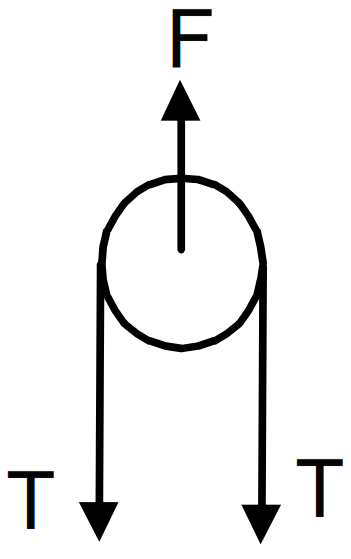
  2. The force exerted by the clamp on the pully is given by
$F - 2T = 0$
$F = 2T = 2 \times 3.9 = 7.8N.$

Need a full question paper?

Generate a complete, print-ready paper with questions like this in minutes — across 16+ boards, with answer keys.

Start Generating Free

Similar questions

The short-wavelength limit shifts by 26pm when the operating voltage in an X-ray tube is increased to 1.5 times the original value. What was the original value of the operating voltage?
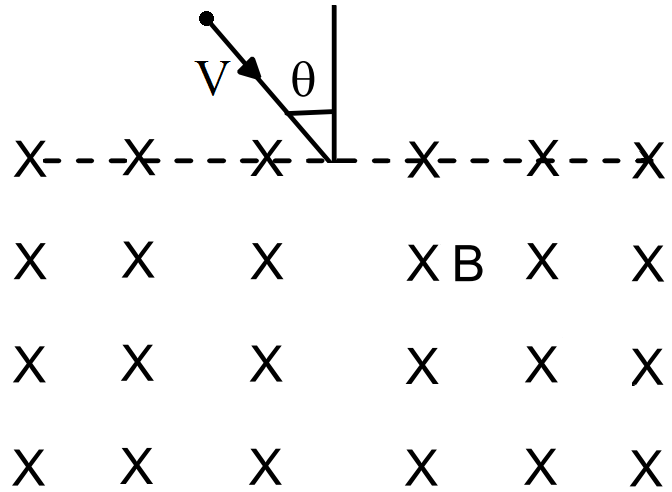
A particle of mass m and positive charge q, moving with a uniform velocity v, enters a magnetic field B, as shown,
  1. Find the radius of the circular arc it describes in the magnetic field.
  2. Find the angle subtended by the arc at the centre.
  3. How long does the particle stay inside the magnetic field?
  4. Solve the three parts of the above problem if the charge q on the particle is negative.
When a metal plate is exposed to a monochromatic beam of light of wavelength 400nm, a negative potential of 1.1V is needed to stop the photocurrent. Find the threshold wavelength for the metal.
A compound microscope consists of an objective lens of focal length 2.0 cm and an eyepiece of focal length 6.25 cm separated by a distance of 15 cm. How far from the objective should an object be placed in order to obtain the final image at (a) the least distance of distinct vision (25 cm), and (b) at infinity? What is the magnifying power of the microscope in each case?
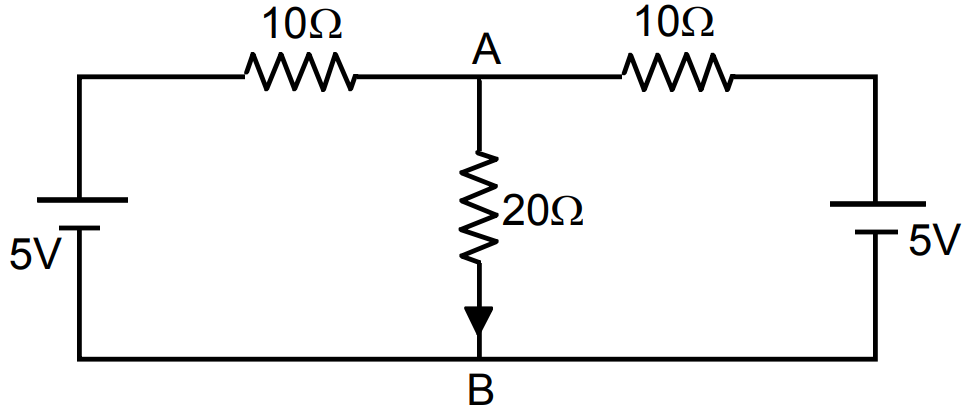
(a) Find the current in the $20\Omega$ resistor shown in the figure. (b) If a capacitor of capacitance $4\mu\text{F}$ is joined between the points A and B, what would be the electrostatic energy stored in it in steady state?
A parallel-plate capacitor of capacitance $5\mu\text{F}$ is connected to a battery of emf 6V. The separation between the plates is 2mm:
  1. Find the charge on the positive plate.
  2. Find the electric field between the plates.
  3. A dielectric slab of thickness 1mm and dielectric constant 5 is inserted into the gap to occupy the lower half of it. Find the capacitance of the new combination.
  4. How much charge has flown through the battery after the slab is inserted?
If the outer coil of the previous problem is rotated through 90° about a diameter, what would be the magnitude of the magnetic field B at the centre?
The resistance of an iron wire and a copper wire at 20°C are $3.9\Omega$ and $4.1\Omega,$ respectively. At what temperature will the resistance be equal? Temperature coefficient of resistivity for iron is $5.0\times10^{-3}\text{K}^{-1}$ and for copper, it is $4.0\times10^{-3}\text{K}^{-1}.$ Neglect any thermal expansion.
A beam of white light is incident normally on a plane surface absorbing 70% of the light and reflecting the rest. If the incident beam carries 10W of power, find the force exerted by it on the surface.
Explain "Electron Theory of Electric Charge".